Hip Replacement Surgery Cost in Hyderabad
Hip Replacement Cost at Wellness Hospitals
Our orthopaedic team plans each surgery around the patient's hip, not a fixed template. Starting prices by type of surgery are below.
| Type of surgery | Starting price (INR) | What changes the final cost |
|---|---|---|
| Total hip replacement (one hip) | Starts from ₹1,26,500, implants extra | Implant, room category, health conditions |
| Partial hip replacement (hemiarthroplasty) | Starts from ₹95,000, implants extra | Implant, room category, reason for surgery |
| Bilateral hip replacement (both hips) | Starts from ₹2,25,000, implants extra | Implants, room category, fitness assessment |
| Revision hip replacement | Estimate after consultation | Complexity of the earlier surgery, implant |
*Approximate costs. The final cost may vary for each patient.
The total hip replacement price is based on a minimum 5-day hospital stay. The actual stay and cost depend on each patient's condition.
Approximate costs. The final cost may vary for each patient. Room category, implant, type of surgery and your health conditions all affect the estimate. Implant charges are extra for every type of hip replacement. Your surgeon confirms a personal estimate after examining your hip and reviewing X-rays.
To get a clear estimate for your hip, book a consultation or call +91 955 955 1 955.
What Is Hip Replacement Surgery?
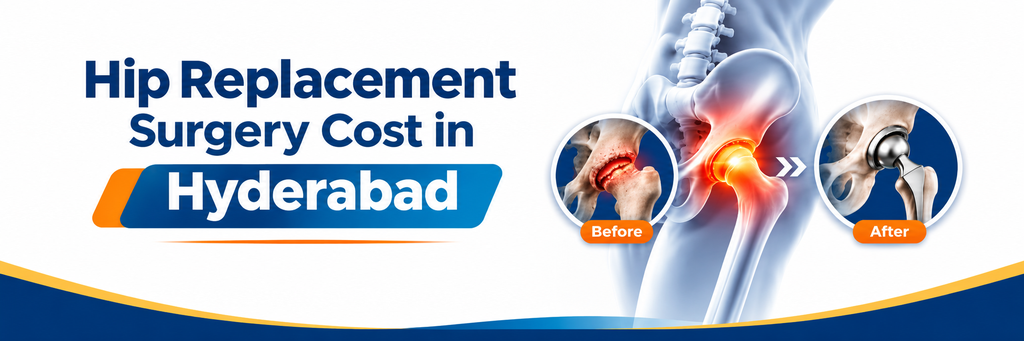
Hip replacement, also called hip arthroplasty, replaces a damaged hip joint with artificial parts. The hip is a ball-and-socket joint. The ball is the top of the thigh bone (femoral head) and the socket is part of the pelvis (acetabulum). When both surfaces are worn or broken, walking, standing and sleeping can become painful. Surgery can reduce pain and improve movement, but results vary from patient to patient.
Types of Hip Replacement
Which type suits you is a surgeon's decision after examination and imaging. Not every patient is suitable for both hips in one sitting.
| Type | What it means | Usually considered when |
|---|---|---|
| Total hip replacement | Both the ball and the socket are replaced | Arthritis or avascular necrosis has damaged the whole joint |
| Partial hip replacement (hemiarthroplasty) | Only the ball (femoral head) is replaced | A fracture of the neck of the thigh bone, often in older patients |
| Bilateral hip replacement | Both hips are replaced | Both hips are badly affected and the patient is fit for a larger surgery |
| Revision hip replacement | An earlier implant is replaced or corrected | The earlier implant has worn, loosened or become infected |
When Is Hip Replacement Recommended?
Surgery is usually considered after non-surgical treatment has been tried, except in cases such as a hip fracture, where it may be advised urgently. Your orthopaedic surgeon may discuss it if you have:
- Severe, constant hip or groin pain that disturbs sleep or daily activity
- Stiffness, a limp, or difficulty walking, climbing stairs, or putting on shoes and socks
- Advanced osteoarthritis, rheumatoid arthritis or arthritis after an injury, confirmed on X-ray
- Avascular necrosis, where the blood supply to the top of the thigh bone is reduced and the bone weakens
- A fracture of the neck of the thigh bone
- Little relief from medicines, physiotherapy, weight management, walking aids or injections
Key Takeaway: An examination and hip X-rays decide whether surgery is right for you. Many people improve with non-surgical care, and your surgeon will say so if that is the better option.
When to Seek Medical Care
Seek emergency care straight away if you fall and have severe hip pain, cannot put weight on your leg, or your leg looks shortened or turned outward. After surgery, contact your doctor if you notice increasing redness, fever, severe swelling, or pain that is getting worse, and seek emergency care for sudden chest pain, sudden breathlessness, or a swollen, painful, warm calf.
How the Cost of Hip Replacement Breaks Down
Knowing where the money goes helps you compare quotes fairly. A hip replacement bill is usually made up of the parts below. Ask which of them are included in your estimate.
| Cost category | What it covers |
|---|---|
| Surgeon's fee | The orthopaedic surgeon's professional fee |
| Anaesthesia | The anaesthetist and anaesthesia for the operation |
| Implant | The ball, socket and stem components chosen for your hip. Implants are charged extra for hip replacement surgery. |
| Operation theatre | Theatre use, equipment and surgical staff |
| Room and nursing | Your room category and nursing care during the stay |
| Medicines and consumables | Medicines, dressings and other supplies |
| Tests | Blood tests, X-rays, ECG and other checks before surgery |
| Physiotherapy | Exercises and rehabilitation after surgery |
Quick Tip: Ask for a written estimate that shows what is included, and what could be charged on top, such as a longer stay, ICU care or extra tests.
What Affects the Cost of Hip Replacement?
Two patients having the same operation can receive different estimates. The main reasons are:
- Type of surgery. Total, partial, bilateral and revision surgery differ in the work involved and the stay needed. Revision surgery is usually more complex than a first-time replacement.
- Implant type and material. This is often one of the biggest factors. Implants differ in make and material, and the choice changes the price. The choice of bearing (the surfaces that rub together) also matters. Your surgeon will explain the options that suit your age, activity and bone quality.
- How the implant is fixed. Some implants are fixed with bone cement and some without. Your surgeon chooses based on your bone quality.
- Room category. A general ward or shared room costs less than a private room. It changes the total without changing the surgery.
- Health conditions. Diabetes, heart disease, obesity or infection risk may need extra tests, medicines or monitoring.
- Planned or urgent surgery. A hip fracture often needs surgery soon after the injury, and the estimate depends on the patient's condition.
- Length of stay and rehabilitation. The total hip replacement price is based on a minimum 5-day stay. The actual stay depends on the patient, and a longer stay or a different physiotherapy plan can change the estimate.
- Insurance and schemes. Cashless cover can reduce what you pay yourself. Check your eligibility early.
Key Takeaway: When you compare quotes from any hospital, ask the same questions: which type of surgery, one hip or both, which implant, and which charges are included.
Hip Implants Explained
A hip implant has several parts: a stem that sits in the thigh bone, a ball (head) on top of the stem, and a cup that sits in the socket. The materials of the ball and cup are called the bearing. Your surgeon recommends the implant that suits your age, activity level, bone quality and any allergies.
Implant charges are separate from the starting prices for all hip replacement surgeries. Your surgeon will explain the options and quote the implant cost at your consultation.
| Bearing type | What it is | Points to discuss with your surgeon |
|---|---|---|
| Metal-on-polyethylene | A metal ball with a plastic (polyethylene) cup | A long-established combination; ask whether it suits your age and activity |
| Ceramic-on-polyethylene | A ceramic ball with a plastic cup | Ask how it compares for wear and cost in your case |
| Ceramic-on-ceramic | A ceramic ball with a ceramic cup | Ask whether it suits your age and activity, and what it adds to the estimate |
Tests Before Hip Replacement
Before surgery you may need tests so the team can confirm you are fit for anaesthesia and surgery. Which tests you need depends on your age and health. They commonly include:
- X-ray of the pelvis and both hips
- MRI or other scans, if your surgeon needs more detail
- Blood tests, including a complete blood count
- ECG, to check your heart
- Other checks for existing conditions such as diabetes or high blood pressure
Test charges are part of your estimate, so ask what is included.
Hospital Stay and Recovery After Hip Replacement
Most patients stay in hospital for a few days. Recovery differs from patient to patient. Most patients are advised to start walking with support soon after surgery, and your surgeon will guide the timing for you. Physiotherapy is an important part of recovery. A structured plan helps restore movement and strength.
| Stage | What to expect |
|---|---|
| In hospital | A few days of stay, pain control, first steps with a walker or support, and early physiotherapy |
| First weeks | Swelling and stiffness are common; follow your exercise plan, wound care advice and your surgeon's advice on movements to avoid |
| Weeks to months | Gradual return to light daily activity, with regular physiotherapy and follow-up visits |
| Long term | Strength and confidence keep improving; your surgeon will tell you which activities to avoid |
Insurance and Cashless Cover
Hip replacement is often covered by health insurance when it is medically necessary, for example for severe arthritis, avascular necrosis or a fracture, subject to the policy terms, waiting periods, room limits and pre-authorisation. Our insurance desk can help you check your cover before admission.
Before You Decide: Questions and Checklist
Questions to ask your doctor
- Do I need a total or partial hip replacement, and why?
- Which implant and bearing do you recommend for me, and why?
- What is included in my estimate, and what could add to it?
- How much physiotherapy will I need, and when can I walk, climb stairs and drive?
- Which movements should I avoid after surgery, and for how long?
- Does my insurance cover this, and what is my likely out-of-pocket cost?
Patient checklist for your consultation
- Photo ID and any insurance card or policy details
- Earlier hip X-rays, MRI or other reports, if you have them
- A list of your current medicines and any allergies
- Details of other conditions such as diabetes, high blood pressure or heart disease
- Details of any earlier hip or joint surgery
Our Orthopaedic Team and Branches
The orthopaedics department treats arthritis, joint pain, fractures, ligament and sports injuries, and offers knee and hip replacement with physiotherapy and rehabilitation.
| Doctor | Qualification | Areas of focus | Branch | Profile |
|---|---|---|---|---|
| Dr Rajashekar | MBBS, MS Ortho, Fellowship in Joint Replacement | Total hip and knee replacement, knee arthroscopy, ligament reconstruction, complex trauma | Sangareddy | View profile |
| Dr Vidya Sagar Reddy Kunreddy | MBBS, DNB Orthopaedics | Joint replacement, arthroscopy, sports medicine, complex trauma including pelvic and acetabular fractures | Begumpet, Lal Bungalow | View profile |
Wellness Hospitals serves patients across Hyderabad and Telangana, including Kompally, Nizamabad, Sangareddy, Begumpet, Lal Bungalow, Leelanagar and Hastinapuram. Book a hip consultation at your nearest branch; see the hospitals page for all locations.
Branch phone: +91 955 955 1 955 (Sangareddy: +91 955 955 1 500).Hip replacement surgery cost in Hyderabad depends on the type of surgery (total, partial, bilateral or revision), the implant, your room category, the length of stay and your health. At Wellness Hospitals, total hip replacement for one hip starts from ₹1,26,500, with implants charged extra. Your surgeon gives a personal estimate after consultation and X-ray. Call +91 955 955 1 955.Hip replacement surgery cost in Hyderabad depends on the type of surgery (total, partial, bilateral or revision), the implant, your room category, the length of stay and your health. At Wellness Hospitals, total hip replacement for one hip starts from ₹1,26,500, with implants charged extra. Your surgeon gives a personal estimate after consultation and X-ray. Call +91 955 955 1 955.