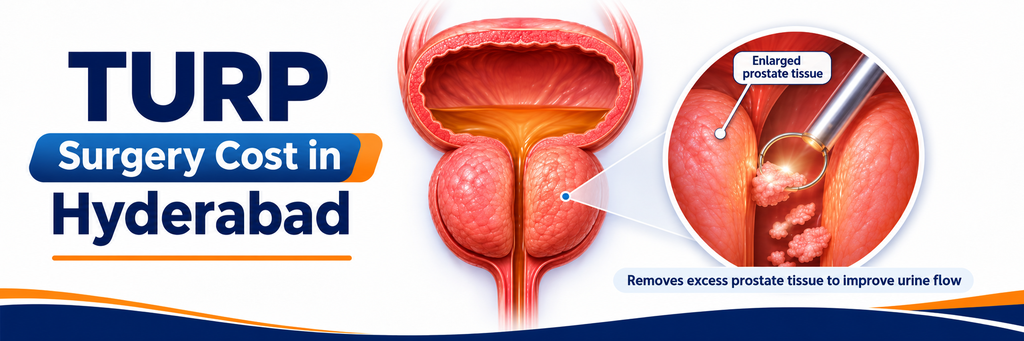
TURP Surgery Cost in Hyderabad
TURP cost at a glance
- TURP (transurethral resection of the prostate): ₹84,000 – ₹1,10,000
- Laser prostate surgery: please ask our advisor
- Cystoscopy (day care), a scope test of the bladder and urethra: ₹22,000 – ₹30,000
- Cystolithotripsy (bladder stone removal): ₹53,000 – ₹70,000
What decides the price
- The size of the prostate, and how long the operation takes
- The equipment and technique your urologist uses
- Tests before surgery, the length of your stay and how long the catheter is needed
- Any complications
TURP surgery cost in Hyderabad at Wellness Hospitals
| Procedure | Price | Note |
|---|---|---|
| TURP (transurethral resection of the prostate) | ₹84,000 – ₹1,10,000 | Please ask our advisor what your estimate includes |
| Laser prostate surgery | Ask our advisor | Priced after your urologist's evaluation |
*Approximate costs. The final cost may vary for each patient.
Please note: the price above is a guide, not a fixed quote. Where your price falls within the range depends on the size of your prostate, how long the operation takes, your tests, the length of your stay, other health conditions and any complications. Your final bill may differ if extra tests, medicines or days in hospital are needed. If your urologist changes the plan after evaluation, the cost will be decided accordingly. Please contact our advisor when you ask for an estimate, and ask for it in writing before surgery.
Related urology costs at Wellness Hospitals
Men with an enlarged prostate sometimes need a scope test, or treatment for a bladder stone. These are the related prices.
| Procedure | Price | Note |
|---|---|---|
| Cystoscopy (day care) | ₹22,000 – ₹30,000 | A thin telescope looks inside the urethra and bladder |
| Cystolithotripsy (bladder stone removal) | ₹53,000 – ₹70,000 | A stone in the bladder is broken up and removed |
*Approximate costs. The final cost may vary for each patient.
What affects the cost of TURP?
The size of the prostate. A larger prostate takes longer to trim, which lengthens the operation.
The equipment and technique. TURP can be done with different equipment, and laser prostate surgery is a different operation with its own cost. Please ask our advisor what equipment your estimate covers.
Tests before surgery. A urine test, a blood test including PSA, an ultrasound of the bladder and prostate, and sometimes a urine flow test or a scope test help plan the operation. Ask which are included.
Anaesthesia and theatre. The surgical team, anaesthesia and operation theatre use are part of the bill.
Length of stay and the catheter. Most men stay a short time and go home with the catheter removed. A longer stay, or treatment for bleeding or infection, changes the cost.
Other health conditions. Diabetes, heart or lung problems, or blood-thinning medicines may mean extra tests or care.
Medicines and follow-up. Medicines after surgery, and follow-up visits are part of recovery.
Insurance. The limits and terms in your policy decide how much your insurer pays, and you pay any amount that is not covered.
The full cost of TURP
When you plan your budget, look beyond the operation price:
- Tests before surgery, including the PSA blood test and the ultrasound. Ask which are included in your estimate.
- Which equipment or technique your price covers, and what laser surgery would cost.
- Consultation and medicines. Ask which are included, and plan for the ones you take at home.
- Follow-up visits. Ask what is included.
- Time away from work. Recovery takes a week or two for light work.
- Insurance limits. Check your waiting period and any limits in your policy.
What is BPH?
The prostate is a small gland below the bladder that surrounds the urine tube (the urethra). With age, it often grows. This non-cancerous enlargement is called benign prostatic hyperplasia (BPH). As the gland grows, it squeezes the urethra, and the bladder has to push harder to empty. Over time, the bladder muscle can weaken, and urine may be left behind.
Symptoms of an enlarged prostate
- A weak or slow urine stream, or a stream that stops and starts
- Passing urine often, including several times at night
- A sudden, urgent need to pass urine
- Straining to start, or the feeling that the bladder is never fully empty
- Dribbling after you finish
- In some men, repeated urine infections, blood in the urine, or being unable to pass urine at all
Treatment before surgery
Most men with BPH are treated with medicines first, and surgery is for those who do not improve or who develop problems. Your urologist may suggest:
- Medicines that relax the muscle at the neck of the bladder, or that shrink the prostate
- Drinking less in the evening, and less tea, coffee and alcohol
- Treating constipation, and passing urine on a regular schedule
- Regular check-ups, including a PSA blood test and an ultrasound
When is surgery advised?
Surgery such as TURP is usually advised when:
- Medicines have not helped enough, or cause side effects
- You cannot pass urine at all (urinary retention)
- You have repeated urine infections
- A stone has formed in the bladder
- There is blood in the urine from the prostate
- The bladder is not emptying and the kidneys are under strain
Your urologist decides after examining you and doing the tests.
What is TURP?
TURP stands for transurethral resection of the prostate. It is the standard operation to trim the part of an enlarged prostate that blocks the flow of urine. The surgeon passes a thin telescope (a resectoscope) through the urethra, so no cut is made on the skin. A small cutting loop on the telescope removes the obstructing tissue in thin pieces, and the pieces are washed out. A catheter is then placed to drain the bladder while the area heals.
Who is TURP suitable for?
Your urologist chooses the operation after your tests. TURP is often used for:
- Men with a moderately enlarged prostate
- Men who have moderate to severe symptoms that medicines have not eased
- Men with complications such as urinary retention, repeated infections or bladder stones
TURP may not be the right choice if:
- Your prostate is very large. Laser surgery or open surgery may be better.
- You have a urine infection that has not been treated. It has to be cleared first.
- You take blood thinners that cannot be stopped. Your urologist will talk through the options.
TURP or laser prostate surgery?
| TURP | Laser prostate surgery | |
|---|---|---|
| What it is | A cutting loop on a telescope trims the prostate | A laser removes or vaporises the prostate tissue |
| Cut on the skin | None | None |
| Suits | Many men with a moderately enlarged prostate | Larger prostates, and some men on blood thinners |
| Catheter and stay | Often a few days | Often shorter |
| Cost at Wellness Hospitals | ₹84,000 – ₹1,10,000 | Ask our advisor |
*Approximate costs. The final cost may vary for each patient.
Neither is better for everyone. Your urologist recommends the operation that suits your prostate and your health, and the price should not decide it.
Tests before TURP
- Urine test and urine culture, to check for infection
- PSA blood test, and other blood tests, including kidney function
- Ultrasound of the bladder and prostate, which shows the size of the prostate and how much urine is left behind
- Urine flow test, in some cases
- Cystoscopy, a scope test of the urethra and bladder, in some cases
- ECG and other tests, to check that you are fit for anaesthesia
Your urologist will tell you which tests you need.
How to prepare for TURP
- Follow the instructions you are given about when to stop eating and drinking
- Tell your doctor about all your medicines, especially blood thinners such as aspirin, clopidogrel or warfarin. Do not stop any medicine unless you are told to.
- Tell the team about allergies and other health conditions
- Any urine infection must be treated before the operation
- You may be given antibiotics to prevent infection
- Bring your reports, insurance details and a photo ID, and bring a family member
How is TURP done?
- Anaesthesia. You are given spinal or general anaesthesia.
- The telescope. A thin telescope is passed through the urethra into the prostate. There is no cut on the skin.
- Trimming the prostate. The surgeon trims away the tissue that blocks the urine, and washes out the pieces.
- The catheter. A catheter is placed in the bladder, often with fluid running through it to keep the urine clear.
- Recovery. You are watched as you wake up.
The operation often takes about one hour, and longer for a large prostate. Your urologist will explain the plan for your case.
Is TURP painful?
You are under anaesthesia, so you do not feel pain during the operation. Afterwards, many men have a burning feeling, an urge to pass urine and bladder spasms, mostly from the catheter. Your team gives you pain relief and medicines for the spasms, and it settles over days.
Recovery after TURP
Recovery differs for each person. This is a general guide, and your urologist will tell you what applies to you.
| When | What to expect |
|---|---|
| Day of the operation | You wake up in the recovery area with a catheter in place. The urine is pink or red at first. |
| Days 1 to 3 | The catheter is often removed after about two to three days, once the urine is clear. A burning feeling, frequent urination and small clots are common. Drink plenty of fluids. |
| Weeks 1 to 2 | Many men return to desk work. Avoid heavy lifting and straining. A little blood in the urine can come and go. |
| Weeks 4 to 6 | The area heals fully, and the urine flow keeps improving. Your urologist tells you when you can lift, drive long distances and have sex. |
After TURP: side effects
- Retrograde ejaculation. This is common. The semen goes back into the bladder, so you have little or no fluid at orgasm. It is harmless, but it can affect fertility, so talk to your urologist before surgery if you want children.
- Erections. TURP does not usually affect the ability to have an erection, and desire and orgasm are normally unchanged.
- Urgency or leakage. Some men have an urgent need to pass urine, or a little leakage, for a few weeks. It usually settles. Lasting loss of bladder control is uncommon, and pelvic floor exercises may help.
- Blood in the urine. A little blood and small clots are common for a few weeks.
After TURP: care
- Drink plenty of water to keep the urine clear
- Eat fibre and take stool softeners if needed, to avoid straining
- Avoid heavy lifting, straining and strenuous exercise for about four to six weeks, or as advised
- Do not drive in the first week, or as long as your urologist says
- Wait for your urologist's go-ahead before sex
- Take your medicines as prescribed, and keep your follow-up visits
Risks of TURP
TURP is generally safe, but every operation has risks. They include bleeding, a urine infection, retrograde ejaculation, temporary leakage or urgency, a narrowing of the urine tube or the bladder neck that may need treatment, a reaction to the anaesthesia and, rarely, absorption of the washing fluid into the blood. Newer equipment lowers some of these risks, and your urologist will tell you what is used. Your urologist will explain the risks that apply to you.
Can the prostate grow back after TURP?
The tissue that was trimmed does not grow back, but the rest of the gland can slowly grow again over many years. A small number of men need another treatment later. Regular check-ups help.
When is difficulty passing urine an emergency?
Go to the nearest emergency department, or call +91 955 955 1 955, if you:
- Cannot pass urine at all
- Have severe pain in the lower abdomen
- Have fever with chills and burning urine
Being unable to pass urine needs urgent treatment.
When to call your doctor after TURP
- Urine that turns dark red, or large clots that block the flow
- Fever or chills
- Being unable to pass urine
- Pain that is getting worse
- A burning feeling that is not settling
In an emergency, go to the nearest emergency department.
TURP cost with insurance and cashless cover
Many health insurance policies cover TURP when it is medically needed for an enlarged prostate, subject to your policy terms and waiting periods. Check them before you plan.
Wellness Hospitals offers cashless treatment where your policy or scheme covers it, with an insurance helpdesk available 24/7. Call +91 955 955 1 955 (Sangareddy branch: +91 955 955 1 500). Cashless approval is decided by your insurer, and any amount not approved is payable by the patient or family. See how cashless treatment at Wellness Hospitals works.
Get an estimate
Call +91 955 955 1 955 to speak to our team or book a consultation. Bring your reports, including your PSA and ultrasound results, and your insurance details.