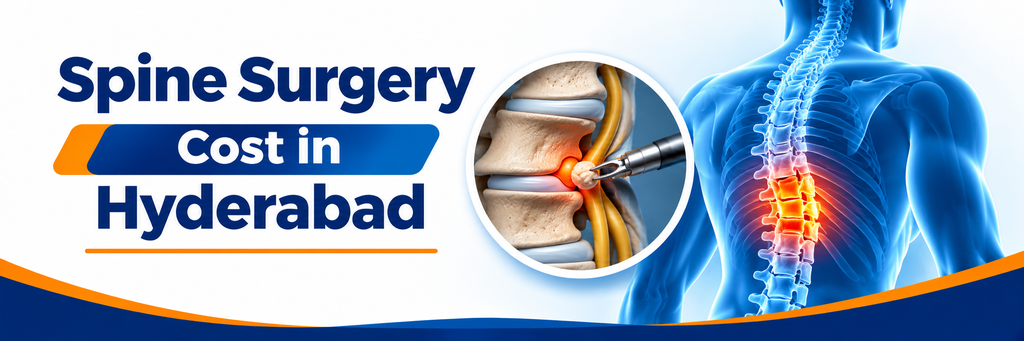
Spine Surgery Cost in Hyderabad
Back and neck problems are worrying enough without a surprise bill. This page gives you the price of each spine procedure at Wellness Hospitals, explains what can change the final amount, and then covers what the surgery involves, how recovery goes, and when to get urgent help.
Spine surgery cost at a glance
- Lower back (lumbar) laminectomy or discectomy, one level: ₹91,000 – ₹1,20,000
- Lower back, two levels: ₹1,14,000 – ₹1,50,000
- Neck (cervical) laminectomy or discectomy, one level: ₹1,21,000 – ₹1,50,000
- Neck, two levels: ₹1,44,000 – ₹1,80,000
- Endoscopic (keyhole) surgery, one level: ₹1,53,000 – ₹2,00,000 for the lower back, and ₹1,83,000 – ₹2,30,000 for the neck
- Spinal fixation, one or two levels: ₹1,37,000 – ₹2,20,000, implants extra
- Cervical spine fixation, one or two levels: ₹1,67,000 – ₹2,50,000
What decides the price
- Type of procedure: a single-level discectomy costs less than a fixation with implants
- Number of levels: each extra level adds to the operation
- Open or endoscopic approach
- Implants: screws and rods are charged extra for spinal fixation
Spine surgery cost in Hyderabad by procedure
| Procedure | Price | Note |
|---|---|---|
| Lumbar laminectomy or discectomy (slip disc surgery), one level | ₹91,000 – ₹1,20,000 | |
| Lumbar laminectomy or discectomy, two levels | ₹1,14,000 – ₹1,50,000 | |
| Endoscopic lumbar laminectomy or discectomy, one level | ₹1,53,000 – ₹2,00,000 | |
| Cervical laminectomy or discectomy, one level | ₹1,21,000 – ₹1,50,000 | |
| Cervical laminectomy or discectomy, two levels | ₹1,44,000 – ₹1,80,000 | |
| Endoscopic cervical laminectomy or discectomy, one level | ₹1,83,000 – ₹2,30,000 | |
| Spinal fixation, one level | ₹1,37,000 – ₹1,80,000 | Implants extra |
| Spinal fixation, two levels | ₹1,68,000 – ₹2,20,000 | Implants extra |
| Cervical spine fixation, one level | ₹1,67,000 – ₹2,10,000 | Implants extra |
| Cervical spine fixation, two levels | ₹1,98,000 – ₹2,50,000 | Implants extra |
*Approximate costs. The final cost may vary for each patient.
Surgery on more than two levels, and other spine procedures such as scoliosis correction or kyphoplasty, cost ₹1,30,000 to ₹1,80,000 at Wellness Hospitals, with implants extra.
Please note: the prices above are a guide, not a fixed quote. Where your price falls within a range depends on factors such as the part of the spine involved, the number of levels, whether the surgery is open or endoscopic, any implants, your ICU needs, the length of your stay, other health conditions and any complications. Spinal and cervical spine fixation prices do not include implants. Your final bill may differ if extra tests, medicines, ICU care or days in hospital are needed. If your surgeon changes the plan after evaluation, the cost will be decided accordingly. Please contact our advisor when you ask for an estimate, and ask for it in writing before surgery.
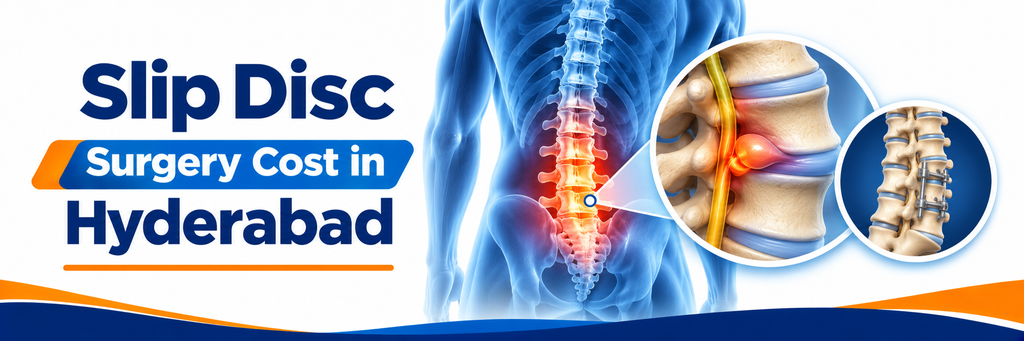
Slip disc surgery cost in Hyderabad
A slipped disc, also called a herniated or prolapsed disc, happens when the soft centre of a disc pushes out and presses on a nerve. It is most common in the lower back, at the L4-L5 and L5-S1 levels, where L4, L5 and S1 are names for the bones of the lower spine. It can cause back pain and sciatica, which is pain that runs down the leg. Most slipped discs improve without surgery. When surgery is needed, these are the prices at Wellness Hospitals.
| Slip disc procedure | Price |
|---|---|
| Lower back disc surgery (lumbar discectomy), one level, such as L4-L5 | ₹91,000 – ₹1,20,000 |
| Lower back disc surgery, two levels | ₹1,14,000 – ₹1,50,000 |
| Endoscopic lower back disc surgery, one level | ₹1,53,000 – ₹2,00,000 |
| Neck disc surgery (cervical discectomy), one level | ₹1,21,000 – ₹1,50,000 |
| Endoscopic neck disc surgery, one level | ₹1,83,000 – ₹2,30,000 |
*Approximate costs. The final cost may vary for each patient.
Read more in our guide to slip disc surgery cost in Hyderabad.
Spinal fixation is added only if the spine is unstable, and its price is in the table above. Artificial disc replacement is priced after your surgeon's evaluation, so please ask our advisor.
What affects the cost of spine surgery?
Type of procedure. Taking pressure off a nerve (laminectomy or discectomy) is a smaller operation than fixing the bones of the spine in place (fixation), which uses screws and rods.
Number of levels. A level is one section of the spine between two vertebrae. Surgery on two levels takes longer than on one, and costs more.
Part of the spine. Neck (cervical) and lower back (lumbar) surgery are priced differently, because the operations are different.
Open or endoscopic approach. Open surgery uses a longer cut so the surgeon can see the spine directly. Endoscopic surgery uses a very small opening and a thin camera, and needs special equipment.
Implants. Screws, rods and other hardware are charged extra for spinal fixation. Ask what your surgeon plans to use, and what it will cost.
ICU and length of stay. Some patients need ICU monitoring, and a longer stay adds to the bill.
Tests. An MRI, a CT scan, X-rays and blood tests help plan the surgery. Ask which are included in your estimate.
Anaesthesia, theatre and surgical team. The neurosurgeon's team, anaesthesia and operation theatre use are part of the bill.
Other health conditions. Diabetes, heart or lung problems, or an infection may mean extra tests or care before surgery.
Complications. Extra treatment or a longer stay for a complication changes the cost.
Rehabilitation. Physiotherapy and follow-up visits after discharge add to the total cost of recovery.
Insurance. The limits and terms in your policy decide how much your insurer pays, and you pay any amount that is not covered.
The full cost of spine surgery
When you plan your budget, look beyond the procedure price:
- MRI and other scans. Ask whether they are included in your estimate.
- Implants. For spinal fixation these are extra, so ask for their cost.
- Consultation and medicines. Ask which are included, and plan for medicines after discharge.
- Physiotherapy. Most patients need it, sometimes for weeks.
- Follow-up visits and scans. Ask whether they are included.
- Insurance limits. Check your waiting period and any limits in your policy before you plan.
What is spine surgery?
Spine surgery treats problems of the bones, discs and nerves of the back and neck. Traditionally it is done as open surgery, with a longer cut so the surgeon can see the spine directly. Over time, surgeons have developed minimally invasive techniques that use small cuts, thin tubes, small cameras and special instruments to reach the problem with less damage to nearby muscle.
One of the newest forms is full endoscopic spine surgery. The surgeon passes a thin camera and fine instruments through a very small opening to remove the part of a disc or bone that is pressing on a nerve. Whether a keyhole approach is possible depends on your problem, and your surgeon will advise.
Why is spine surgery done?
The spinal cord runs down the back, and nerves branch from it to the arms, chest, abdomen and legs. They control movement and feeling, and they help control the bladder and bowels. When bone, a disc, an injury, an infection or a tumour presses on these nerves, surgery can help to:
- Take pressure off the spinal cord or a nerve root (decompression)
- Steady a spine that is unstable or painful
- Correct a deformity, such as a curve of the spine
Surgery is usually advised when other treatment has not worked, or when nerve damage is getting worse.
Common spine problems
- Slipped disc (herniated disc): the soft centre of a disc pushes out and presses on a nerve, causing pain, numbness or weakness in the arm or leg
- Sciatica: pain that runs from the lower back down the leg, often because a nerve is pinched
- Spinal stenosis: the spinal canal narrows and squeezes the nerves, often in older people
- Degenerative disc disease: over time, the discs wear down and lose their cushioning, causing pain and stiffness
- Spondylolisthesis: one vertebra slips forward over the one below it
- Scoliosis: the spine curves sideways
- Neck (cervical) nerve problems: pressure on the nerves or spinal cord in the neck, causing arm pain, numbness or clumsiness
- Unstable spine or fracture: bones that move too much or have broken, from injury, wear or weak bones
- Spinal tumours: growths in or near the spine
Who needs spine surgery?
Not everyone with back pain needs surgery, and other treatment usually comes first. Surgery may be considered when:
- The pain is severe and continues even after other treatment
- Nerve damage is causing weakness, numbness, or loss of control of your bladder or bowels
- The spine is unstable, which can lead to deformity or a higher risk of injury
- The spinal cord or a nerve root is under pressure
Your surgeon decides after an examination and your scans.
Symptoms that can point to a spine problem
- Back or neck pain that does not settle
- Pain that runs down a leg or an arm
- Numbness or tingling in the arms, hands, legs or feet
- Weakness in a limb, or trouble gripping or walking
- A feeling that the legs are heavy, or walking short distances is hard
When is back pain an emergency?
Go to the nearest emergency department, or call +91 955 955 1 955, if you have:
- Sudden weakness in the legs
- Loss of control of your bladder or bowels, or being unable to pass urine
- Numbness in the groin or inner thighs
- Severe back or neck pain after an injury, or a fall
- Back pain with fever and general illness
These can mean the spinal cord or nerves are in danger, and they need urgent treatment.
Treatment before surgery
Most back pain improves with time and non-surgical care. Your doctor will usually try these first:
- Short rest, then gentle activity as advised
- Medicines for pain and swelling
- Physiotherapy and exercises
- Injections, for some patients
- Changes to posture, lifting and weight
Surgery is considered when pain, weakness or numbness continues despite this, or when there are warning signs such as loss of bladder or bowel control.
How are spine problems diagnosed?
Your surgeon examines you, checks your reflexes, strength and feeling, and asks how the pain behaves. The usual tests are:
- MRI, which shows discs, nerves and the spinal cord
- CT scan, which shows the bones clearly
- X-rays, including bending views, to check whether the spine is stable
- Nerve tests, in some cases
- Blood tests, to check that you are fit for surgery
Your surgeon will tell you which tests you need.
Types of spine surgery
- Discectomy (microdiscectomy): the surgeon removes the part of a slipped disc that is pressing on a nerve, to relieve leg or arm pain, numbness or weakness.
- Laminectomy (decompression): the surgeon removes part of the bone at the back of the spinal canal, called the lamina, to make more room for the nerves.
- Endoscopic discectomy or decompression: the same aim, done through a very small opening with a thin camera. This includes percutaneous endoscopic lumbar discectomy (PELD) and full endoscopic surgery, through the side or the back of the spine.
- Spinal fixation (stabilisation): the surgeon joins bones of the spine and holds them steady with screws and rods, often together with fusion, so they heal into one solid piece. It is used for an unstable or painful spine.
- Neck (cervical) surgery: discectomy, laminectomy or fixation in the neck, to relieve pressure on the nerves or the spinal cord.
- Surgery for fractures and curves: procedures such as kyphoplasty for a broken vertebra and scoliosis correction for a curved spine. They cost ₹1,30,000 to ₹1,80,000, with implants extra.
Open, minimally invasive and endoscopic spine surgery
| Open surgery | Minimally invasive | Endoscopic | |
|---|---|---|---|
| Cut | A longer cut | Smaller cuts, often with thin tubes | A very small opening |
| View | Direct view | Through a tube, camera or microscope | Through a thin camera |
| Pain and muscle damage | Usually more | Usually less | Usually least |
| Recovery | Often longer | Often quicker | Often quicker still |
| Suits | Complex or wide problems | Many disc and decompression problems | Selected disc and nerve problems |
| Cost at Wellness Hospitals | See the price table above | See the price table above | See the price table above |
Your surgeon recommends the approach that is safest and most effective for you. A keyhole approach is not possible for every problem.
How is spine surgery done?
- Anaesthesia. You are given general anaesthesia, or in some endoscopic operations a local or epidural anaesthetic.
- Reaching the spine. The surgeon makes a cut, or a very small opening, over the affected part of the spine.
- The repair. The surgeon removes the disc piece or bone that is pressing on the nerve. For fixation, screws and rods are placed to hold the spine steady.
- Closing. The cut is closed, and you are watched as you wake up.
- Getting up. Most patients are helped to stand and walk soon after surgery, as the surgeon advises.
Your surgeon will explain the plan for your case.
How to prepare for spine surgery
- Follow the instructions you are given about when to stop eating and drinking
- Tell your doctor about all your medicines, especially blood thinners and diabetes medicines. Do not stop any medicine unless you are told to.
- Tell the team about allergies and other health conditions
- Stop smoking, because it slows healing, especially for fusion
- Bring your MRI, CT and other reports, insurance details and a photo ID
- Plan for a family member to stay with you and help you at home
Recovery and aftercare
Recovery differs for each person and each procedure. This is a general guide, and your surgeon will tell you what applies to you.
| When | What to expect |
|---|---|
| First days | Soreness at the wound. You are helped to walk, and you are shown how to move safely. |
| First weeks | Avoid bending, lifting and twisting for the first three to six weeks, or as advised. Walk a little every day. |
| About 2 weeks | Light activity can often begin again. |
| About 6 weeks | Routine activity can often resume. |
| About 12 weeks | Strenuous work or contact sports may be allowed, if your surgeon agrees. |
- Keep the wound clean and dry, and do not soak it in a bath or pool until your surgeon allows
- Use ice packs on the area for swelling, as advised
- After fixation or fusion, eat a balanced diet with enough calcium and protein
- Ask your surgeon which painkillers are safe after fusion surgery, because some medicines can affect bone healing
- Do not smoke
- Do the physiotherapy your team recommends
- Keep your follow-up visits and scans
When to call your doctor after surgery
- Fever or chills
- Redness, swelling or discharge from the wound
- Severe or worsening pain
- New numbness or weakness in your arms or legs
- Trouble passing urine or stool
- Breathing problems
- Pain, swelling or redness in a leg
In an emergency, go to the nearest emergency department.
Risks of spine surgery
Spine surgery is common and generally safe, but every operation has risks. They include infection, bleeding, a reaction to the anaesthesia, pain that continues, a tear in the covering of the spinal cord (which can leak spinal fluid), nerve injury, a blood clot in the legs, an implant that loosens, and the problem coming back. Your surgeon will explain the risks that apply to you.
Spine surgery cost with insurance and cashless cover
Many health insurance policies cover spine surgery when it is medically needed, subject to your policy terms, waiting periods and limits on implants. Check them before you plan.
Wellness Hospitals offers cashless treatment where your policy or scheme covers it, with an insurance helpdesk available 24/7. Call +91 955 955 1 955 (Sangareddy branch: +91 955 955 1 500). Cashless approval is decided by your insurer, and any amount not approved is payable by the patient or family. See how cashless treatment at Wellness Hospitals works.
Get an estimate
Call +91 955 955 1 955 to speak to our team or book a consultation. Bring your MRI and other reports, and your insurance details.