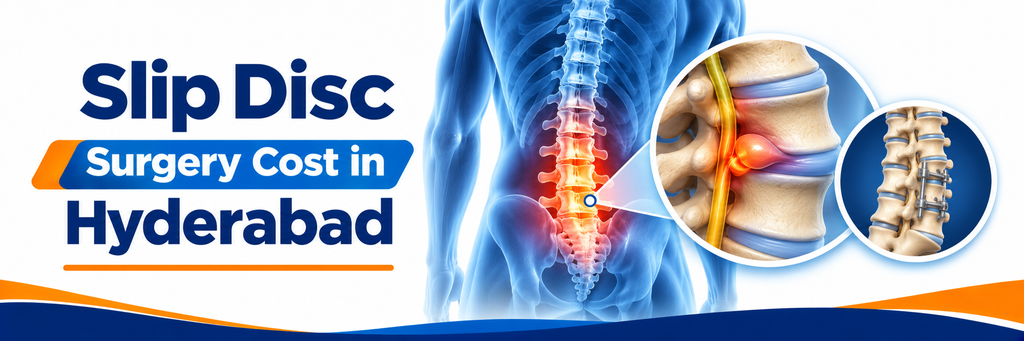
Slip Disc Surgery Cost in Hyderabad
Slip disc surgery cost at a glance
- Lower back (lumbar) disc surgery, one level, such as L4-L5: ₹91,000 – ₹1,20,000
- Lower back, two levels: ₹1,14,000 – ₹1,50,000
- Endoscopic (keyhole) lower back surgery, one level: ₹1,53,000 – ₹2,00,000
- Neck (cervical) disc surgery, one level: ₹1,21,000 – ₹1,50,000
- Neck, two levels: ₹1,44,000 – ₹1,80,000
- Endoscopic neck surgery, one level: ₹1,83,000 – ₹2,30,000
What decides the price
- Where the slipped disc is: the lower back or the neck
- How many levels need surgery
- Open or endoscopic surgery
- Whether the spine is also unstable, which needs fixation with implants
Slip disc surgery cost in Hyderabad at Wellness Hospitals
| Procedure | Price | Note |
|---|---|---|
| Lower back (lumbar) laminectomy or discectomy, one level | ₹91,000 – ₹1,20,000 | Please ask our advisor which technique your estimate covers |
| Lower back laminectomy or discectomy, two levels | ₹1,14,000 – ₹1,50,000 | |
| Endoscopic lower back laminectomy or discectomy, one level | ₹1,53,000 – ₹2,00,000 | Keyhole approach |
| Neck (cervical) laminectomy or discectomy, one level | ₹1,21,000 – ₹1,50,000 | |
| Neck laminectomy or discectomy, two levels | ₹1,44,000 – ₹1,80,000 | |
| Endoscopic neck laminectomy or discectomy, one level | ₹1,83,000 – ₹2,30,000 | Keyhole approach |
*Approximate costs. The final cost may vary for each patient.
Please note: the prices above are a guide, not a fixed quote. Where your price falls within a range depends on which part of the spine is involved, how many levels are treated, whether the surgery is open or endoscopic, your tests, the length of your stay, other health conditions and any complications. Your final bill may differ if extra tests, medicines, ICU care or days in hospital are needed. If your surgeon changes the plan after evaluation, the cost will be decided accordingly. Please contact our advisor when you ask for an estimate, and ask for it in writing before surgery.
If the spine is also unstable
A disc operation takes pressure off the nerve. If the spine is also unstable, your surgeon may add spinal fixation, which holds the bones steady with screws and rods. These are the related prices.
| Procedure | Price | Note |
|---|---|---|
| Spinal fixation, one level | ₹1,37,000 – ₹1,80,000 | Implants extra |
| Spinal fixation, two levels | ₹1,68,000 – ₹2,20,000 | Implants extra |
| Cervical spine fixation, one level | ₹1,67,000 – ₹2,10,000 | Implants extra |
| Cervical spine fixation, two levels | ₹1,98,000 – ₹2,50,000 | Implants extra |
*Approximate costs. The final cost may vary for each patient.
Read more in our guide to spine surgery cost in Hyderabad.
What affects the cost of slipped disc surgery?
The part of the spine. Lower back and neck operations are different operations and are priced differently.
The number of levels. A level is one disc and the bones above and below it. Surgery on two levels takes longer than on one.
Open or endoscopic surgery. Open surgery uses a small cut and, often, a microscope. Endoscopic surgery uses a very small opening and a thin camera, and needs special equipment, so it costs more.
Fixation and implants. Most disc operations need no implants. If your spine is unstable and needs fixation, the implants are charged extra.
Tests before surgery. An MRI is the main scan, and your surgeon may also ask for X-rays, a CT scan and blood tests. Ask which are included in your estimate.
Anaesthesia, theatre and surgical team. These are part of the bill.
Length of stay and ICU. Most patients need only a short stay, but a longer stay or ICU care adds to the cost.
Other health conditions. Diabetes, heart or lung problems, or an infection may mean extra tests or care before surgery.
Physiotherapy and follow-up. Rehabilitation after surgery is part of the total cost of recovery.
Insurance. The limits and terms in your policy decide how much your insurer pays, and you pay any amount that is not covered.
The full cost of slipped disc treatment
When you plan your budget, look beyond the operation price:
- MRI and other scans. Ask which are included in your estimate.
- Which technique your price covers, and what another technique would cost.
- Implants, if fixation is needed.
- Consultation and medicines, including the medicines you take before surgery.
- Physiotherapy. Most patients need it for some weeks.
- Follow-up visits and scans. Ask whether they are included.
- Insurance limits. Check your waiting period and any limits in your policy.
What is a slipped disc?
Your spine is a stack of bones (vertebrae), and between them sit discs that work as cushions. They absorb the shocks of walking, lifting and twisting. Each disc has a tough outer ring and a soft, jelly-like centre. If the outer ring weakens or tears, the centre can push out. This is a slipped disc. The part that pushes out can press on a nearby nerve, which causes pain, numbness or weakness in the area that nerve supplies.
One problem, many names
People use several names for the same problem, and you may hear any of them:
- Slip disc or slipped disc: the everyday name
- Herniated disc: the soft centre has pushed through the outer ring
- Prolapsed disc: another word for a herniated disc
- Ruptured disc: a herniated disc where the outer ring has torn
- Bulging disc: the disc pushes out, but the outer ring has not torn through
The name matters less than where the disc is, how much it presses on a nerve, and what symptoms you have.
Where does a slipped disc happen?
- Lower back (lumbar spine): the most common site, especially the discs at L4-L5 and L5-S1. These names are the bones on either side of the disc. Pressure here often causes sciatica, which is pain running down the leg.
- Neck (cervical spine): the discs at C5-C6 and C6-C7 are the most often affected. Pressure here often causes pain, tingling or weakness in the arm and hand.
- Upper back: a slipped disc is rare here.
Symptoms of a slipped disc
Lower back disc:
- Back pain, often with pain running down one leg
- Tingling, burning or numbness in the leg or foot
- Weakness in the leg, or a foot that drags
- Pain that is worse when you sit, cough, sneeze or bend
Neck disc:
- Neck pain and stiffness
- Pain, tingling or numbness in the shoulder, arm or hand
- Weakness in the arm, or trouble gripping
The pain and its type differ from person to person, and the symptoms often affect one side of the body.
Who gets a slipped disc?
A slipped disc is most common between about 30 and 50 years of age, and it affects men more often than women. It can happen at other ages too. Things that raise the chance are:
- Wear in the discs that comes with age
- Lifting heavy things, or lifting while twisting
- Sitting for long hours, or driving long distances
- Being overweight
- Smoking
- An earlier back injury
- A family history of disc problems
When is a slipped disc an emergency?
Go to the nearest emergency department, or call +91 955 955 1 955, if you have:
- Sudden weakness in the legs
- Loss of control of your bladder or bowels, or being unable to pass urine
- Numbness in the groin or inner thighs
- Severe back or neck pain after an injury or a fall
These can mean the spinal cord or nerves are in danger, and they need urgent treatment.
Treatment of a slipped disc, step by step
Most slipped discs get better without an operation, so treatment usually begins gently.
Step 1: the first weeks. Your doctor may advise pain relief medicines, a short rest followed by gentle activity, and avoiding heavy lifting and painful positions. Physiotherapy and a back exercise programme help to stretch and strengthen the back. Heat or ice, and a change in how you sit and lift, also help.
Step 2: if the pain does not settle. Your doctor may add stronger medicines, such as muscle relaxants or medicines for nerve pain, and may suggest an injection near the nerve.
Step 3: surgery. If your symptoms have not improved after about six weeks of proper treatment, or if the nerve is getting worse, your surgeon may advise an operation.
When is surgery advised?
Surgery is usually considered when:
- Pain, numbness or weakness continues after about six weeks of treatment
- The muscles are getting weaker, for example a foot that drags or a weak grip
- The pain is so severe that you cannot work, sleep or walk
- There are warning signs, such as loss of bladder or bowel control
Your surgeon decides after an examination and your MRI.
Slip disc operations
- Microdiscectomy: the surgeon removes the part of the disc that presses on the nerve, through a small cut, often using a microscope. It is the most common operation for a lower back slipped disc.
- Endoscopic discectomy: the same aim, done through a very small opening with a thin camera, which may mean less pain and a quicker recovery for suitable patients.
- Laminectomy: the surgeon removes a small part of the bone at the back of the spinal canal, to make more room for the nerve.
- Neck (cervical) discectomy: the disc that presses on a nerve in the neck is removed. In some cases the gap is then filled or the bones are fixed.
- Spinal fixation: added only if the spine is unstable. Screws and rods hold the bones steady.
Open or endoscopic disc surgery?
| Open (microscope) surgery | Endoscopic surgery | |
|---|---|---|
| Cut | A small cut | A very small opening |
| View | Direct view, often with a microscope | Through a thin camera |
| Pain and recovery | Often quicker than old-style open surgery | Often quicker still |
| Suits | Most slipped discs, including more than one level | Selected disc and nerve problems |
| Cost at Wellness Hospitals | Lower back ₹91,000 – ₹1,20,000 for one level, neck ₹1,21,000 – ₹1,50,000 | Lower back ₹1,53,000 – ₹2,00,000, neck ₹1,83,000 – ₹2,30,000 |
*Approximate costs. The final cost may vary for each patient.
A keyhole approach is not possible for every disc. Your surgeon recommends the safest and most effective approach for you.
Tests for a slipped disc
- Examination: your surgeon checks your reflexes, strength and feeling
- MRI scan, which shows the disc and the nerves clearly
- X-rays, including bending views, and sometimes a CT scan
- Nerve tests, in some cases
- Blood tests, to check that you are fit for surgery
Your surgeon will tell you which tests you need.
How to prepare for slip disc surgery
- Follow the instructions you are given about when to stop eating and drinking
- Tell your doctor about all your medicines, especially blood thinners and diabetes medicines. Do not stop any medicine unless you are told to.
- Tell the team about allergies and other health conditions
- Stop smoking, because it slows healing
- Bring your MRI and other reports, insurance details and a photo ID
- Plan for a family member to stay with you and to help you at home
How is slip disc surgery done?
- Anaesthesia. You are given general anaesthesia, or for some endoscopic operations a local or epidural anaesthetic.
- Reaching the disc. The surgeon makes a small cut, or a very small opening, over the affected disc.
- Freeing the nerve. The surgeon removes the piece of disc, and any bone, that presses on the nerve.
- Closing. The wound is closed, and you are watched as you wake up.
- Getting up. Most patients are helped to stand and walk soon after surgery, as the surgeon advises.
Your surgeon will explain the plan for your case.
Recovery after slip disc surgery
Recovery differs for each person and each operation. This is a general guide, and your surgeon will tell you what applies to you.
| When | What to expect |
|---|---|
| Day of surgery | Soreness at the wound. Leg or arm pain often eases quickly. You are helped to walk and shown how to move safely. |
| First week | Short walks every day. Avoid bending, lifting and twisting. Numbness can take longer to fade than pain. |
| About 2 weeks | Light activity can often begin again. |
| About 6 weeks | Routine activity can often resume. Your surgeon may start strengthening exercises. |
| About 12 weeks | Heavier work or sport may be allowed, if your surgeon agrees. |
Looking after your back after surgery
- Keep the wound clean and dry
- Walk a little every day, and do the physiotherapy your team recommends
- Avoid bending, lifting and twisting for the first weeks, as advised
- Lift with your knees, not your back, and keep heavy things close to your body
- Keep a healthy weight, and do not smoke
- Keep your follow-up visits and scans
Risks of slip disc surgery
Slip disc surgery is common and generally safe, but every operation has risks. They include infection, bleeding, a reaction to the anaesthesia, pain that continues, a tear in the covering of the nerves (which can leak spinal fluid), nerve injury, a blood clot in the legs, and the disc slipping again. Your surgeon will explain the risks that apply to you.
When to call your doctor after surgery
- Fever or chills
- Redness, swelling or discharge from the wound
- Severe or worsening pain
- New numbness or weakness in your arms or legs
- Trouble passing urine or stool
- Pain, swelling or redness in a leg
In an emergency, go to the nearest emergency department.
Slip disc surgery cost with insurance and cashless cover
Many health insurance policies cover slip disc surgery when it is medically needed, for example when pain, weakness or nerve pressure continues after other treatment. Cover depends on your policy terms, waiting periods and limits, including limits on implants. Check them before you plan.
Wellness Hospitals offers cashless treatment where your policy or scheme covers it, with an insurance helpdesk available 24/7. Call +91 955 955 1 955 (Sangareddy branch: +91 955 955 1 500). Cashless approval is decided by your insurer, and any amount not approved is payable by the patient or family. See how cashless treatment at Wellness Hospitals works.
Get an estimate
Call +91 955 955 1 955 to speak to our team or book a consultation. Bring your MRI and other reports, and your insurance details.