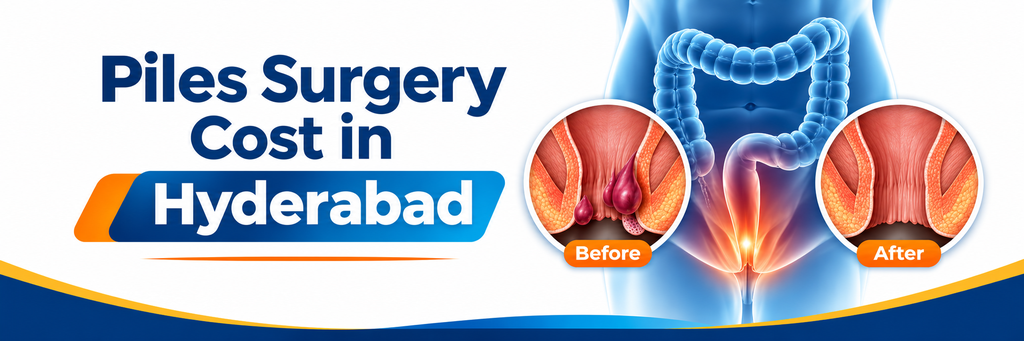
Piles Surgery Cost in Hyderabad
Piles Surgery Cost in Hyderabad
These prices cover the surgeon's fee, anaesthesia, operation theatre charges, room, nursing and routine post-operative medicines, and laser use for laser surgery. Prices run from a general ward to a deluxe room. Room categories are offered according to your choice and availability. Please contact our advisor for an estimate.
| Procedure | Approx. cost |
|---|---|
| Laser piles surgery (laser haemorrhoidectomy) | ₹61,000 – ₹80,000 |
| Fissurectomy or sphincterotomy (anal fissure) | ₹76,000 – ₹1,00,000 |
| Fistulectomy (anal fistula) | ₹61,000 – ₹80,000 |
*Approximate costs. The final cost may vary for each patient.
Please note: the prices above are a guide, not a fixed quote. Your final bill depends on factors such as the grade of your piles, whether you have internal and external piles together, whether a pile is thrombosed or infected, your room category, the length of your stay, and any other health conditions you have. It may also differ if extra tests, medicines, days in hospital or other care are needed. If your surgeon advises a different treatment after evaluation, the cost will be decided accordingly. Ask our team for a written estimate before surgery.
Laser vs Conventional Piles Surgery
Both methods can treat piles. Laser surgery suits many grade 2, grade 3 and some grade 4 piles, mainly internal piles and some external piles. Conventional surgery is often preferred for large or advanced piles. Your surgeon recommends the method that is right for you.
| Laser surgery | Conventional surgery | |
|---|---|---|
| Cutting and stitches | None | Yes, and the wound needs time to heal |
| Hospital stay | Often day care | Often longer |
| Recovery | Often a few days | Often a few weeks |
| Pain after surgery | Usually less | Usually more |
| Risk of bleeding and infection | Often lower | Often higher |
| Piles coming back | Can happen, more so in advanced piles | Less likely, though still possible |
| Cost | See the price table above | Estimate after your surgeon's evaluation |
What Affects the Cost of Piles Surgery?
Grade of piles. Grade 2 and 3 piles are usually simpler to treat than grade 4 piles, which are permanently prolapsed and can be more complex. A higher grade can mean a longer procedure and a longer stay.
Type of piles. Some people have internal and external piles together. A thrombosed or infected pile, or an abscess, may need extra care and can change the cost.
Treatment method. Laser surgery and conventional surgery are priced differently, and your surgeon recommends the method that suits your piles.
Room category and stay. A general ward is the most affordable option. A private room or an extra night adds to the package price.
Tests before surgery. Blood tests, and sometimes a colonoscopy if the bleeding is unusual or you are older, help your surgeon plan safely. Ask which tests are included in your estimate.
Other health conditions. Diabetes, high blood pressure, heart or lung problems may mean extra tests or specialist clearance before surgery.
Planned or urgent treatment. Planned surgery is scheduled after your assessment. Urgent treatment, for example for a severely painful thrombosed pile, may involve extra care and monitoring.
The Full Cost of Piles Treatment
When you plan your budget, look beyond the package price:
- Consultation and tests. Ask which are included in your estimate and which are billed separately.
- Medicines. Routine medicines are covered in the package. Special dressings or extra medicines may cost more.
- Follow-up visits. Ask whether they are included in your estimate.
- Time off work. Laser surgery usually means a shorter break from work than conventional surgery.
- Insurance limits. Check your policy's room-rent limit and waiting period before you choose a room.
What Are Piles (Haemorrhoids)?
Piles, also called haemorrhoids, are swollen blood vessels in the anus and lower rectum. Everyone has soft cushions of blood vessels and tissue there, which help control the passing of stool. They become a problem when repeated pressure, usually from straining, constipation or sitting for long periods, makes them swell, bleed or slip down out of position. Piles are very common, and most can be managed without a major operation.
Symptoms of Piles
- Bright red blood on the toilet paper, in the pan, or coating the stool, usually without pain
- Itching, irritation or burning around the anus
- A soft lump you can feel near the anal opening
- A feeling that your bowel has not emptied completely
- Mucus discharge and a damp feeling around the anus
- Discomfort or aching when you sit, especially for long periods
Bleeding from the back passage should never simply be assumed to be piles. It is the commonest cause, but the same symptom can come from a fissure, an infection or a more serious condition. Bleeding that lasts more than a few days, or comes with a change in bowel habit or weight loss, needs a proper examination.
Internal and External Piles
Internal piles form inside the rectum, above the anal opening, where there are few pain nerves. They are usually painless and show up mainly as bright red bleeding. Larger internal piles can slip down through the anus during a bowel movement, which is called prolapse.
External piles form under the skin around the anus, where there are many pain-sensitive nerves. They cause itching, swelling, discomfort and a lump you can feel. If a blood clot forms inside one, it becomes a thrombosed pile, which is suddenly and sharply painful.
Some people have both types together. Your surgeon will examine you and advise whether laser treatment suits both.
The Four Grades of Piles
Doctors grade internal piles from 1 to 4 by how far they come down. The grade helps decide the treatment.
| Grade | What happens | Usual treatment |
|---|---|---|
| Grade 1 | Small swellings inside the anal canal, not visible outside. They may bleed. | Diet, fibre and stool softeners |
| Grade 2 | They come down during a bowel movement but go back in on their own. | Diet, plus banding or laser if they persist |
| Grade 3 | They come down and have to be pushed back in by hand. | Banding or laser surgery, as your surgeon advises |
| Grade 4 | They stay down and cannot be pushed back. They are often painful and may become thrombosed. | Surgery is usually needed, laser or conventional, as your surgeon advises |
What Causes Piles?
Piles develop when the veins around the anus are under repeated pressure. Common causes include long-term constipation and straining, a low-fibre diet, sitting for long periods, pregnancy, being overweight, heavy lifting and ageing, which weakens the supporting tissue. Many of these can be changed, which is why lifestyle changes are the foundation of both treatment and prevention.
When to See a Doctor
Most piles are not an emergency, but see a doctor if bleeding is heavy or does not stop, if a pile stays down, or if your symptoms do not settle with diet and simple measures.
Get care the same day if you have:
- A sudden, hard, very painful lump at the anus, which may be a thrombosed pile
- Heavy or continuous bleeding, or bleeding with dizziness
- Bleeding with a change in bowel habit or unexplained weight loss
- Bleeding after the age of 40 that has never been examined
- Fever, severe anal pain or pus, which can mean an abscess
Call +91 955 955 1 955, or go to the nearest emergency department.
How Are Piles Diagnosed?
Diagnosis is quick and is usually done in the clinic. The surgeon asks about your symptoms and examines the area. A short examination with a small lubricated instrument (proctoscopy) lets the internal piles and their grade be seen directly. If the bleeding is unusual, keeps coming back, or you are older, your surgeon may advise a colonoscopy to make sure the bleeding is not coming from higher up. A correct diagnosis matters, because a fissure, a fistula or another condition is treated differently.
Piles or Fissure?
Piles and anal fissures are often confused because both can cause bleeding. The easiest way to tell them apart is the pain. Piles bleeding is usually painless. A fissure is a small tear in the lining of the anus, and it causes sharp, burning pain during and after a bowel movement.
| Piles | Anal fissure | |
|---|---|---|
| Main symptom | Painless bright red bleeding | Sharp, burning pain when passing stool |
| Pain | Usually mild or none | Often severe, and can last for hours afterwards |
| Lump | A soft lump or prolapse is possible | No lump, though a small skin tag may form |
| Cause | Swollen blood vessels in the anus | A tear in the lining of the anus |
If you are not sure which you have, an examination can tell the difference in a few minutes.
Home Care and Non-Surgical Treatment
For grade 1 and many grade 2 piles, symptoms can often be controlled without surgery:
- Fibre and fluids: eat plenty of fruit, vegetables and whole grains, and drink enough water, to keep stool soft and reduce straining
- Warm sitz baths: sit in warm water for 10 to 15 minutes, two or three times a day, to soothe irritation and swelling
- Toilet habits: do not strain, and do not sit on the toilet for long periods with a phone or a book
- Activity: regular movement helps your bowels and reduces pressure on the veins
- Creams and stool softeners: short courses can ease a flare-up, under medical advice
If piles keep bleeding or coming down despite this, a procedure such as rubber band ligation may help grade 2 and some grade 3 piles. For grade 3 and 4 piles, or when other treatment has not worked, laser surgery or another operation may be advised. Home remedies can control mild piles, but they do not cure advanced piles.
How Does Laser Piles Surgery Work?
Laser haemorrhoidoplasty is a minimally invasive treatment that avoids cuts and stitches.
- Anaesthesia. You are given local or spinal anaesthesia, or another type your team advises.
- Laser fibre. A thin laser fibre is passed into the swollen tissue.
- Shrinking. Controlled laser energy shrinks the swollen blood vessels, and the body gradually absorbs the treated tissue.
- No wound. Because nothing is cut, there is no large wound to heal, so pain and bleeding are usually less than with conventional surgery.
The procedure often takes about 15 to 30 minutes, and many patients can go home the same day. Your surgeon will tell you whether laser surgery suits your piles.
How to Prepare for Piles Surgery
- Follow the instructions you are given about when to stop eating and drinking before surgery
- Tell your doctor about all your medicines, especially blood thinners and diabetes medicines
- Tell the team about other health conditions and any allergies
- Bring your reports, insurance details and a photo ID
- Bring a family member or attendant, because you may not be able to go home alone
- Wear loose, comfortable clothes
Recovery After Laser Piles Surgery
Recovery differs from person to person. Many people return to light activity and desk work within a few days, and feel back to normal within a few weeks. Your surgeon will tell you what applies to you.
| When | What to expect | Diet and care |
|---|---|---|
| Day of surgery | You are monitored for a few hours, and many patients go home the same day | Light meals and plenty of water |
| First few days | Mild discomfort. Most people can sit and walk. | High-fibre food, stool softeners as advised, warm sitz baths |
| First week | Discomfort fading and light activity resuming | Fruit, vegetables, whole grains and plenty of water |
| Weeks 2 to 4 | Most people are back to normal activity | Keep up fibre and fluids to help prevent piles coming back |
Avoid heavy lifting and long periods of sitting in the first week, and avoid very spicy and fried food for about two weeks. A high-fibre diet and plenty of water are the most important steps to stop piles coming back.
Possible Risks and Complications
Piles surgery is common and generally safe, but every procedure has risks. Possible problems include pain, bleeding, infection, difficulty passing urine for a short time, a change in bowel control (rare), and piles coming back, especially if constipation and straining continue. Your surgeon will explain the risks that apply to you before surgery.
When to Call Your Doctor After Surgery
- Heavy bleeding
- Fever or chills
- Pain that is getting worse
- Being unable to pass urine
- Pus or a foul-smelling discharge
- Being unable to pass stool
In an emergency, go to the nearest emergency department.
Piles in Pregnancy
Piles are very common in pregnancy. The growing uterus presses on the veins of the pelvis, and constipation adds to the strain, so piles often appear or get worse, especially in the last months and after delivery. Treatment is usually gentle: a high-fibre diet, plenty of water, warm sitz baths and safe measures advised by your doctor. Most piles that start in pregnancy settle after delivery. Surgery is avoided in pregnancy unless there is a serious complication. If piles are troubling you, speak to your obstetrician and our surgical team, so any treatment is safe for you and your baby.
Piles Surgery Cost with Insurance and Cashless Cover
Many health insurance policies cover piles surgery when it is medically needed, subject to your policy terms, waiting period and limits. Some policies have a separate waiting period for piles, so check yours early. Check your room-rent limit and ask whether laser treatment is covered before you plan.
Wellness Hospitals offers cashless treatment where your policy or scheme covers it, with an insurance helpdesk available 24/7. Call +91 955 955 1 955 (Sangareddy branch: +91 955 955 1 500). Cashless approval is decided by your insurer, and any amount not approved is payable by the patient or family. See how cashless treatment at Wellness Hospitals works.
Get an Estimate
Call +91 955 955 1 955 to speak to our team or book a consultation. Bring your reports and your insurance details.