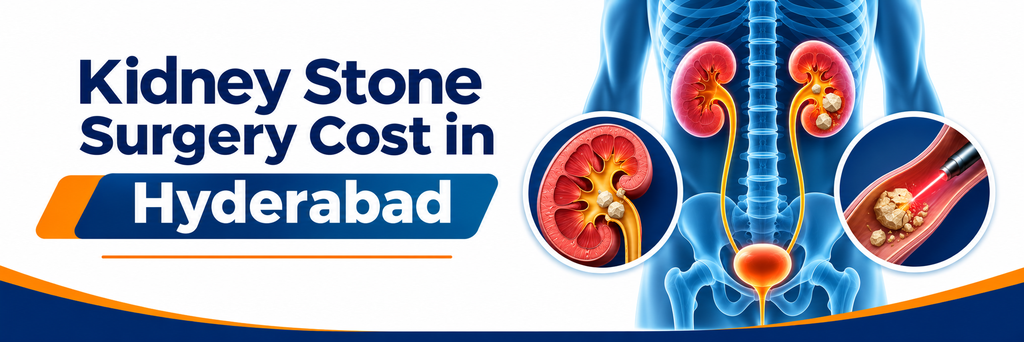
Kidney Stone Surgery Cost in Hyderabad
Kidney Stone Surgery Cost in Hyderabad by Procedure
| Procedure | Approx. cost |
|---|---|
| URS (ureteroscopy) with laser and DJ stent | ₹68,000 – ₹90,000 |
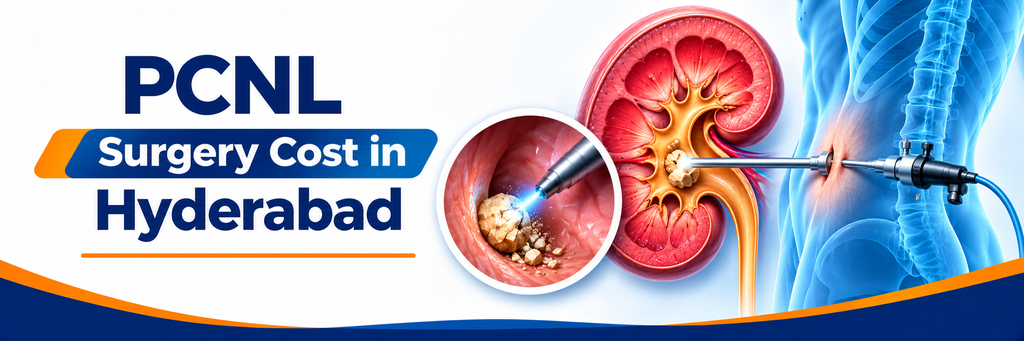
| PCNL (percutaneous nephrolithotomy) with DJ stent | ₹80,000 – ₹1,05,000 |
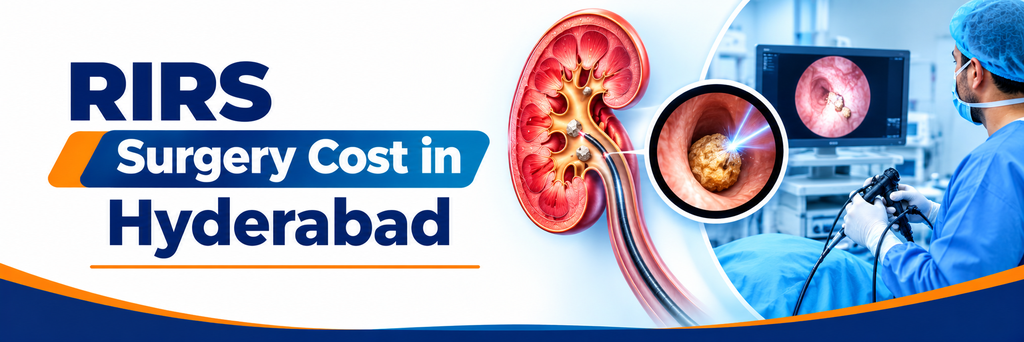
| RIRS (retrograde intrarenal surgery) | ₹1,14,000 – ₹1,50,000 |
| DJ stenting (day care) | ₹35,000 |
| DJ stent removal (day care) | ₹18,000 |
*Approximate costs. The final cost may vary for each patient.
Prices run from a general ward to a deluxe room. The URS with laser and PCNL prices include the double J stent. For ESWL (shock wave lithotripsy), please check with the branch.
These package prices cover the surgeon's fee, anaesthesia, operation theatre charges, equipment, room, nursing, medicines and basic post-operative care. Extra charges may apply for a longer stay, more tests, an extra session or complications. Room categories are offered according to your choice and availability. Please contact our advisor for an estimate.
Please note: the prices above are a guide, not a fixed quote. Where your price falls within a range depends on factors such as the size, number and position of your stones, the procedure your urologist advises, whether you need a stent, your room category, the length of your stay, and any other health conditions you have. Your final bill may differ if extra tests, medicines, days in hospital, a second procedure or other care are needed. If your urologist advises a different procedure after evaluation, the cost will be decided accordingly. Ask our team for a written estimate before the procedure.
Which Kidney Stone Procedure Is Right for You?
The right procedure depends on the size, position and type of your stone, on whether the kidney is blocked or infected, and on your general health. Your urologist decides after examining you and looking at your scans.
ESWL (shock wave lithotripsy). Shock waves are directed at the stone from outside the body. They break it into small pieces, which you pass in the urine over the following days. It involves no cut and suits smaller stones in the kidney or upper ureter. It is usually done as day care. Some stones need more than one session.
URS with laser (ureteroscopy). A thin scope is passed through the urinary passage up to the stone in the ureter. A laser breaks the stone, and the pieces are removed or pass in the urine. There is no cut. A stent is often placed for a short time.
RIRS (retrograde intrarenal surgery). A thin flexible scope is passed through the urinary passage into the kidney. A laser breaks the stones inside the kidney, and the pieces are removed. There is no cut. It is used for kidney stones of about 1 to 2 cm that are not suitable for ESWL. A stent is often placed for a short time.
PCNL (percutaneous nephrolithotomy). A small cut is made in the back, and a tube is passed into the kidney. The stone is broken up and removed through the tube. It is used for large or staghorn stones and needs a longer stay.
What Affects the Cost of Kidney Stone Surgery?
Stone size and position. Larger stones, several stones, or stones in difficult places need more complex procedures and sometimes more than one session.
Type of procedure. ESWL is the least invasive and the least costly. URS, PCNL and RIRS are priced higher, as the table shows.
Double J stent. Many procedures need a thin temporary tube (a double J stent) to help the kidney drain while it heals. The URS with laser and PCNL packages include the stent. Removing it later is a separate day-care procedure, charged at ₹18,000. Ask whether a stent is included in your RIRS estimate.
Repeat sessions. Some stones need more than one ESWL session. Ask what your estimate covers if a second session is needed.
Room category and stay. A general ward is the most affordable. A private room or an extra day adds to the package price.
Tests before the procedure. A scan, urine and blood tests help your urologist plan safely. Ask which are included in your estimate.
Infection and other health conditions. A urine infection may need treatment before a procedure. Diabetes, high blood pressure, or kidney, heart or lung problems may mean extra tests or specialist clearance.
Planned or urgent treatment. A blocked, infected kidney may need urgent drainage, which can change the cost and the plan.
The Full Cost of Kidney Stone Treatment
When you plan your budget, look beyond the package price:
- Consultation and tests. Ask which are included in your estimate and which are billed separately.
- Stent and its removal. The URS and PCNL packages include the stent. Removal is a separate day-care procedure at ₹18,000.
- Medicines. Routine medicines are covered in the package. Extra medicines may cost more.
- Follow-up scans and visits. Ask whether they are included.
- Time off work. Recovery time differs a lot between ESWL and PCNL.
- Insurance limits. Check your policy's room-rent limit and waiting period before you choose a room.
What Are Kidney Stones, and When Is Surgery Needed?
Kidney stones are hard deposits of minerals and salts that form inside the kidneys. Small stones often pass in the urine with plenty of water and medicines. Stones can cause trouble when they are large, block the flow of urine or cause infection. Surgery or another procedure is usually advised when a stone:
- Is larger than about 5 to 6 mm and unlikely to pass on its own
- Causes severe pain, a blockage or an infection
- Sits in the ureter and makes the kidney swell (hydronephrosis)
- Keeps coming back despite preventive measures
Only a urologist can decide which treatment you need.
Symptoms of Kidney Stones
- Severe pain in the side or back that may spread to the groin
- Pain that comes in waves and may make you restless
- Blood in the urine
- Burning or pain when passing urine, or a frequent urge to pass urine
- Nausea or vomiting
- Cloudy or foul-smelling urine
A small stone in the kidney may cause no symptoms at all. Pain often begins when a stone moves into the ureter.
When Is a Kidney Stone an Emergency?
Go to the nearest emergency department, or call +91 955 955 1 955, if you have:
- Severe pain with fever or chills
- Repeated vomiting with severe pain
- Blood in the urine with severe pain
- Little or no urine, or being unable to pass urine
A stone that blocks an infected kidney can be serious and needs urgent treatment.
Types of Kidney Stones and What Causes Them
Most kidney stones are calcium stones. Others are uric acid stones, infection stones and, less often, cystine stones. Stones form when the urine has too little water and too many stone-forming minerals. Common causes and risk factors include:
- Not drinking enough water, or losing a lot of water through heat and sweat
- A diet high in salt, or high in animal protein
- A family history of stones
- Being overweight, or having diabetes or gout
- Repeated urine infections
- Certain medicines and supplements, and some medical conditions
If a stone is removed, your doctor may advise testing it, because the type guides how to prevent more stones.
How Are Kidney Stones Diagnosed?
Your urologist asks about your symptoms and examines you. The usual tests are:
- Urine test, to check for blood and infection
- Blood tests, to check kidney function and the level of minerals
- Ultrasound scan, which shows stones in the kidney and any swelling
- CT scan of the kidneys, ureters and bladder, which shows the size and position of stones clearly
- X-ray of the urinary tract, which can show some stones
Your urologist will tell you which tests you need.
Can a Kidney Stone Pass on Its Own?
Small stones often pass with plenty of water and medicines for pain and to relax the ureter. Stones larger than about 5 to 6 mm are less likely to pass, and a stone that causes severe pain, infection or a blockage needs a doctor's care. Do not ignore pain that does not settle.
The Double J Stent
A double J stent is a thin, soft tube placed between the kidney and the bladder. It keeps the kidney draining while the area heals. You may feel an urge to pass urine, mild discomfort in the side, or a little blood in the urine while it is in place. It is usually removed after one to two weeks. Do not leave a stent in longer than your urologist advises.
How to Prepare for the Procedure
- Follow the instructions you are given about when to stop eating and drinking
- Tell your doctor about all your medicines, especially blood thinners and diabetes medicines
- Tell the team about allergies, earlier surgery, and any urine infection or fever
- Bring your scan reports, blood test reports, insurance details and a photo ID
- Bring a family member or attendant, because you may not be able to go home alone
Recovery After Kidney Stone Surgery
Recovery differs from person to person. This is a general guide, and your urologist will tell you what applies to you.
| Procedure | What to expect |
|---|---|
| ESWL | Mild bruising and some blood in the urine. Many people return to work in a day or two. |
| URS or RIRS | A stent for about one to two weeks. Many people return to work in 3 to 5 days. |
| PCNL | Limited activity for 2 to 3 weeks. Full recovery can take 4 to 6 weeks. |
Your urologist will tell you how long you need to stay in hospital.
After the procedure:
- Drink plenty of water, unless your doctor has told you to limit fluids
- Take your medicines exactly as prescribed, including any antibiotics
- Walk a little every day, and avoid heavy lifting until your urologist says it is safe
- Keep your follow-up appointments, including the one to remove a stent
Possible Risks and Complications
Kidney stone procedures are common and generally safe, but every procedure has risks. Possible problems include pain, blood in the urine, infection, a stone piece that gets stuck, a stone left behind that needs another procedure, injury to the ureter or kidney (rare), and a reaction to anaesthesia. Your urologist will explain the risks that apply to you.
When to Call Your Doctor After the Procedure
- Fever or chills
- Severe pain that is not easing with your medicines
- Heavy bleeding, or clots in the urine
- Being unable to pass urine
- Repeated vomiting
In an emergency, go to the nearest emergency department.
How to Prevent Kidney Stones from Coming Back
Kidney stones often return, but these steps can lower the chance:
- Drink enough water through the day to pass plenty of pale urine
- Eat less salt, and do not eat large amounts of animal protein
- Keep a healthy weight
- Follow the advice your urologist gives after your stone test
- Do not take supplements that you do not need
- Have a scan or check-up if your doctor advises it
Kidney Stone Surgery Cost with Insurance and Cashless Cover
Many health insurance policies cover medically needed kidney stone surgery, subject to your policy terms, waiting period and limits. Some policies have a separate waiting period for kidney stones, so check yours early. Check your room-rent limit and other terms before you plan.
Wellness Hospitals offers cashless treatment where your policy or scheme covers it, with an insurance helpdesk available 24/7. Call +91 955 955 1 955 (Sangareddy branch: +91 955 955 1 500). Cashless approval is decided by your insurer, and any amount not approved is payable by the patient or family. See how cashless treatment at Wellness Hospitals works.
Get an Estimate
Call +91 955 955 1 955 to speak to our team or book a consultation. Bring your scan and other reports, and your insurance details.