Hernia Surgery Cost in Hyderabad
Hernia surgery cost in Hyderabad at Wellness Hospitals ranges from ₹78,000 to ₹1,53,000, depending on the type of hernia and whether surgery is open or laparoscopic.
Laparoscopic (keyhole) repair usually costs more than open surgery, but it often means less pain, smaller scars and a quicker return to normal activity.
Hernia Surgery Cost in Hyderabad by Type of Hernia
| Hernia type | Open surgery | Laparoscopic surgery |
|---|---|---|
| Inguinal (groin), one side | ₹78,000 – ₹1,02,000 | ₹89,000 – ₹1,18,000 |
| Inguinal (groin), both sides | ₹1,01,000 – ₹1,33,000 | ₹1,16,000 – ₹1,53,000 |
| Umbilical (belly button) | ₹78,000 – ₹1,02,000 | ₹89,000 – ₹1,18,000 |
| Incisional (old surgical scar) | ₹85,000 – ₹1,13,000 | ₹98,000 – ₹1,30,000 |
| Complex hernia | ₹1,20,000 | ₹1,20,000 |
*Approximate costs. The final cost may vary for each patient.
Prices run from a general ward to a deluxe room. Room categories are offered according to your choice and availability. Please contact our advisor for an estimate. For hiatal hernia repair, please check with your nearest branch.
These prices cover the surgeon's fee, anaesthesia, operation theatre, room, nursing and routine medicines. Ask our team whether the mesh is included in your estimate. Extra charges may apply for advanced mesh, a longer stay or complications.
Please note: the prices above are a guide, not a fixed quote. Where your price falls within a range depends on factors such as your type of hernia, whether it has come back after earlier surgery, the mesh used, your room category, the length of your stay, and any other health conditions you have. Your final bill may differ if extra tests, medicines, days in hospital or other care are needed. If your operation has to be changed from keyhole to open surgery, the cost will be decided after your surgeon's evaluation. Ask our team for a written estimate before surgery.
Open vs Laparoscopic Hernia Surgery: Cost and Value
Laparoscopic repair costs more than open surgery for every hernia type in the table above, and the gap depends on the type and the case. Whether the extra cost is worth it depends on your hernia and your health, so ask your surgeon.
| Open surgery | Laparoscopic surgery | |
|---|---|---|
| Cuts | One larger cut over the hernia | A few small cuts |
| Pain after surgery | Usually more | Usually less |
| Recovery | Often about 2 to 3 weeks | Often about 1 to 2 weeks |
| Scarring | A larger scar | Small marks |
| Cost | Usually lower | Usually higher |
| When it is used | Suitable for many hernias, including some that are large or complex | Suitable for many hernias, and the usual choice for hiatal hernia |
Both methods repair the hernia, and both usually use mesh to strengthen the weak area. Your surgeon recommends the approach that is safest for you.
What Affects the Cost of Hernia Surgery?
Type of hernia. Inguinal, umbilical, incisional and hiatal hernias are different operations. Incisional, complex and recurrent hernias often take more operating time and may need larger or specialised mesh, which raises the cost.
Surgical technique. Laparoscopic surgery uses advanced equipment, so the price is usually higher than for open surgery. A shorter stay and a quicker recovery can offset part of that.
Mesh. A standard synthetic mesh costs less. Advanced or specially made mesh may be chosen for complex hernias and costs more. Ask your surgeon which mesh is suitable for you.
Room category. A general ward is the most affordable option. Higher room categories raise the price.
Length of stay. Larger hernias, open surgery and complex cases usually need a longer stay, which adds room and nursing charges.
Planned or emergency surgery. Planned surgery is scheduled after your tests. Emergency surgery for a blocked or trapped hernia may involve urgent tests, immediate theatre use and closer monitoring, which can change the cost.
Other health conditions. Diabetes, high blood pressure, heart or lung problems may mean extra tests or specialist clearance before surgery.
The Full Cost of Hernia Surgery
When you plan your budget, look beyond the price:
- Time off work. Open surgery usually means a longer break from work than keyhole surgery, and lost wages can add up.
- Medicines. Routine medicines are covered in the price. Special dressings or extra medicines may cost more.
- Follow-up visits. Ask whether they are included in your estimate.
- Physiotherapy. It is not usually needed for a hernia, but may be advised after a large incisional repair.
- Insurance limits. Check your policy's room-rent limit and waiting period before you choose a room.
What Is a Hernia?
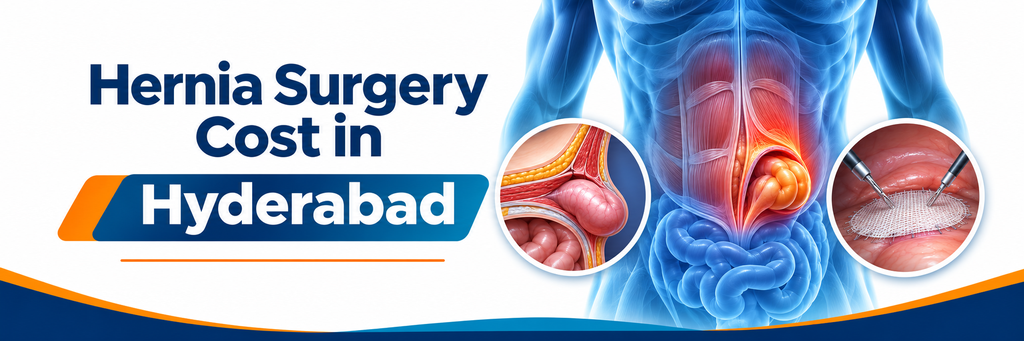
A hernia happens when an organ or fatty tissue pushes through a weak spot in the muscle wall that normally holds it in place. You may see or feel a bulge, most often in the abdomen or groin. The common types are:
- Inguinal hernia: in the groin. It is the most common type and is seen more often in men.
- Umbilical hernia: near the belly button. It can affect babies and adults.
- Incisional hernia: through the scar of an earlier abdominal operation.
- Hiatal hernia: part of the stomach pushes up through the diaphragm into the chest.
Symptoms of a Hernia
- A bulge that is more visible when you stand, cough or strain
- Aching, pulling or burning at the site
- A feeling of heaviness or discomfort in the groin or abdomen
- Pain when you lift, bend or cough
- With a hiatal hernia: heartburn, acid reflux, or difficulty swallowing
Chest pain should always be checked urgently, because it can have causes other than a hernia.
When Is a Hernia an Emergency?
Go to the nearest emergency department, or call +91 955 955 1 955, if a hernia:
- Becomes suddenly painful, hard or tender
- Turns red, purple or dark
- Cannot be pushed back in
- Comes with vomiting, fever, or being unable to pass gas or stool
These can mean the hernia is blocked or its blood supply is cut off. This needs urgent treatment.
Do All Hernias Need Surgery?
Hernias do not heal on their own. A small hernia that causes no symptoms may only be watched, but surgery is the way to repair it. Belts and supports may ease discomfort but do not cure a hernia. Your surgeon will advise whether to operate now or wait, based on the size and type of your hernia and your health.
How Is a Hernia Diagnosed?
Most hernias are diagnosed by examination. Your surgeon may ask you to stand and cough so the bulge is easier to see and feel. An ultrasound or CT scan may be advised if the diagnosis is unclear, if the hernia is large or has come back, or to plan an incisional repair. A hiatal hernia may need a scope test or an X-ray after swallowing a contrast drink. Your surgeon will tell you which tests you need.
Mesh in Hernia Repair
Most hernia repairs use a mesh, a thin sheet that strengthens the weak area. Open repair is sometimes called herniorrhaphy (stitching the weak area) or hernioplasty (repair with mesh). Standard synthetic mesh is used for many repairs. Advanced or specially made mesh may be chosen for complex or recurrent hernias and costs more. Ask your surgeon which mesh is suitable for you and whether it is covered in your estimate.
How Is Hernia Surgery Done?
Open surgery. You are given anaesthesia. The surgeon makes one cut over the hernia, places the bulging tissue back, repairs the weak area and usually places a mesh. The cut is then closed.
Laparoscopic (keyhole) surgery. You are given general anaesthesia. The surgeon makes a few small cuts, passes gas into the abdomen to create room, and uses a thin camera and fine instruments to repair the hernia, usually with a mesh. The cuts are then closed.
Your surgeon recommends the method that is safest for you. Robotic-assisted repair, a form of keyhole surgery done with a robotic system, is offered at some hospitals and usually costs more. The prices on this page are for open and laparoscopic repair. Ask our advisor about other options.
How to Prepare for Hernia Surgery
- Follow the instructions you are given about when to stop eating and drinking before surgery
- Tell your doctor about all your medicines, especially blood thinners and diabetes medicines, which may need to be adjusted
- Tell the team about other health conditions, allergies and any earlier surgery
- Bring your scan reports, blood test reports, insurance details and a photo ID
- Bring a family member or attendant, because you may not be able to go home alone
- Stop smoking if you smoke, because it slows healing
Recovery After Hernia Surgery
Recovery differs from person to person. After open surgery, many people need about 2 to 3 weeks to return to normal activity. After keyhole surgery it is often about 1 to 2 weeks. Incisional and hiatal hernia repairs can take 3 to 4 weeks. Your surgeon will tell you what applies to you.
| When | What to expect | Activity |
|---|---|---|
| Day of surgery | Drowsiness and soreness at the cuts | Rest, and short walks as advised |
| First few days | Soreness, tiredness, and some bruising or swelling | Light movement around the house, no lifting |
| First week | Pain easing and energy returning | Short walks and light tasks |
| Weeks 2 to 4 | Most people feel close to normal | Return to work as advised, then regular activity |
| Follow-up visit | Your surgeon checks the wound and your recovery | Clearance for heavier activity and exercise |
Diet and Activity After Hernia Surgery
- Eat fibre-rich food and drink plenty of water, so you do not strain on the toilet
- Walk a little every day, and increase gradually
- Avoid heavy lifting until your surgeon says it is safe
- Do not drive until your surgeon allows it
- Keep the wounds clean and dry, and follow your care team's advice about bathing
- Return to exercise only after your surgeon has cleared you
Possible Risks and Complications
Hernia repair is a common operation and is generally safe, but every operation has risks. Possible problems include wound infection, bleeding, pain that lasts, a collection of fluid at the site (seroma), the hernia coming back, a problem related to the mesh, injury to nearby structures (rare), and a reaction to anaesthesia. Your surgeon will explain the risks that apply to you before surgery.
When to Call Your Doctor After Surgery
- Fever or chills
- Pain that is getting worse
- Redness, swelling or discharge at a wound
- Repeated vomiting
- A bulge that returns or grows
- Being unable to pass gas or stool
In an emergency, go to the nearest emergency department.
Hernia Surgery Cost with Insurance and Cashless Cover
Many health insurance policies cover medically needed hernia surgery, subject to your policy terms and waiting period. Check your room-rent limit and other terms before you plan.
Wellness Hospitals offers cashless treatment where your policy or scheme covers it, with an insurance helpdesk available 24/7. Call +91 955 955 1 955 (Sangareddy branch: +91 955 955 1 500). Cashless approval is decided by your insurer, and any amount not approved is payable by the patient or family. See how cashless treatment at Wellness Hospitals works.
Get an Estimate
Call +91 955 955 1 955 to speak to our team or book a consultation. Bring your scan and other reports, and your insurance details.
This page is general information and not a substitute for advice from a qualified doctor. Your final bill depends on your medical needs.