Arthroscopy Cost in Hyderabad
A twisted knee, a painful shoulder or a torn ligament is hard enough without worrying about the bill. This page gives you the price of knee ligament surgery at Wellness Hospitals, explains how arthroscopy works for the knee and the shoulder, and covers what can change the cost, how recovery goes, and when to get urgent help.
Arthroscopy cost at a glance
- ACL, MCL or PCL reconstruction or repair: ₹91,000 – ₹1,20,000, implants extra
- Knee arthroscopy (meniscus, cartilage, loose fragments, unstable kneecap): ₹95,000 – ₹1,20,000
- Shoulder arthroscopy (rotator cuff, impingement, frozen shoulder, instability repair): ₹1,20,000 – ₹1,60,000
- Hip arthroscopy (impingement, labral tear): ₹1,20,000 – ₹1,60,000
- Ankle, elbow or wrist arthroscopy: ₹1,20,000 – ₹1,60,000
- Diagnostic arthroscopy: ₹1,20,000 – ₹1,60,000
- If the joint is worn out, total knee replacement: ₹1,14,000 – ₹1,50,000, implants extra
What decides the price
- What is being repaired: a torn ligament, a torn meniscus and a torn rotator cuff are different operations
- Implants and graft: screws, buttons and anchors are charged extra
- How many structures are repaired in one operation
- Length of stay and physiotherapy
Arthroscopy cost in Hyderabad at Wellness Hospitals
| Procedure | Price | Note |
|---|---|---|
| ACL, MCL or PCL reconstruction or repair | ₹91,000 – ₹1,20,000 | Implants extra |
| Knee arthroscopy for a meniscus tear, cartilage problem, loose fragment or unstable kneecap | ₹95,000 – ₹1,20,000 | |
| Shoulder arthroscopy for a rotator cuff tear, impingement or frozen shoulder | ₹1,20,000 – ₹1,60,000 | |
| Shoulder instability repair (Bankart or labral repair) | ₹1,20,000 – ₹1,60,000 | |
| Hip arthroscopy for impingement (FAI) or a labral tear | ₹1,20,000 – ₹1,60,000 | |
| Ankle, elbow or wrist arthroscopy | ₹1,20,000 – ₹1,60,000 | |
| Diagnostic arthroscopy | ₹1,20,000 – ₹1,60,000 | Final price after your surgeon's evaluation |
*Approximate costs. The final cost may vary for each patient.
Please note: the prices above are a guide, not a fixed quote. Where your price falls within a range depends on which ligament or structure is repaired, how many are repaired at once, the graft and implants used, the length of your stay, other health conditions and any complications. Implants are charged extra. Your final bill may differ if extra tests, medicines or days in hospital are needed. If your surgeon changes the plan after evaluation, the cost will be decided accordingly. Please contact our advisor when you ask for an estimate, and ask for it in writing before surgery.
Other joint surgery costs at Wellness Hospitals
If arthroscopy cannot help because the joint is badly worn, your surgeon may talk about a joint replacement. These are the related prices.
| Procedure | Price | Note |
|---|---|---|
| Total knee replacement (one knee) | ₹1,14,000 – ₹1,50,000 | Implants extra |
| Total hip replacement (one hip) | ₹1,26,000 – ₹1,65,000 | Implants extra |
*Approximate costs. The final cost may vary for each patient.
What affects the cost of arthroscopy?
What is being repaired. A torn ACL, MCL or PCL is rebuilt or repaired. A torn meniscus may be trimmed or stitched. A torn rotator cuff is stitched back to the bone. Each is a different operation with a different cost.
Graft and implants. To rebuild an ACL, the surgeon uses a graft, which is a piece of tendon. It is held in place with screws, buttons or anchors. Shoulder repairs use small anchors to fix stitched tissue to the bone. Implants are charged extra, so ask what your surgeon plans to use.
More than one repair. A knee injury often damages more than one structure. Repairing a ligament and a meniscus together takes longer.
Length of stay. Many arthroscopic operations need only a short stay, and a longer stay adds to the bill.
Tests. An MRI, X-rays and blood tests help plan the surgery. Ask which are included in your estimate.
Anaesthesia and theatre. The surgical team, anaesthesia and operation theatre use are part of the bill.
Other health conditions. Diabetes, heart or lung problems may mean extra tests or care before surgery.
Physiotherapy and follow-up. Rehabilitation is a big part of recovery after ligament and shoulder surgery, and it adds to the total cost.
Insurance. The limits and terms in your policy decide how much your insurer pays, and you pay any amount that is not covered.
The full cost of arthroscopy
When you plan your budget, look beyond the operation price:
- MRI and other scans. Ask whether they are included in your estimate.
- Implants. They are extra, so ask for their cost.
- Consultation and medicines. Ask which are included.
- Brace or sling. You may need one for some weeks after surgery.
- Physiotherapy. Most patients need weeks or months of it.
- Follow-up visits. Ask whether they are included.
- Insurance limits. Check your waiting period and any limits in your policy.
What is arthroscopy?
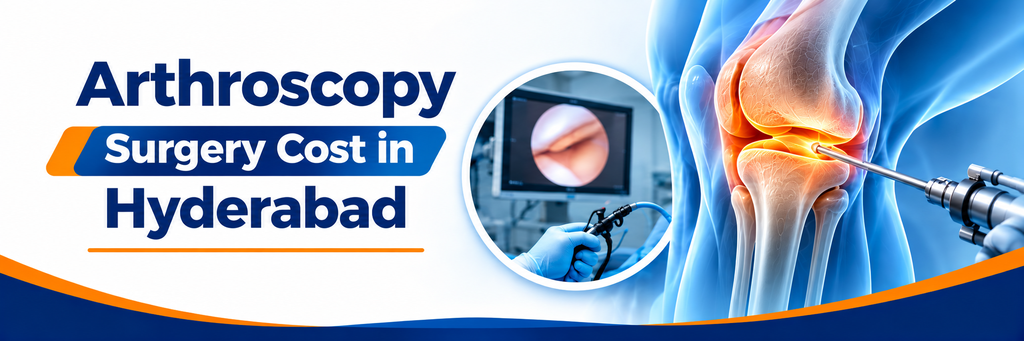
Arthroscopy is keyhole surgery on a joint. The surgeon makes a few small cuts and passes a thin camera (an arthroscope) and fine instruments into the joint. The camera shows the inside of the joint on a screen, so the surgeon can find the problem and repair it, often without opening the joint. It is used for the knee and the shoulder most often, and also for the ankle, hip, elbow and wrist.
Because the cuts are small, arthroscopy often means less pain and a quicker start to recovery than open surgery. It is not right for every problem, and your surgeon will tell you whether it suits yours.
Knee arthroscopy: when is it done?
- A torn meniscus, the cushion of cartilage between the thigh bone and the shin bone, which is trimmed or stitched
- A torn ligament, such as the ACL, which is rebuilt or repaired
- Damaged cartilage on the joint surface
- Loose fragments of bone or cartilage that catch in the joint
- Inflamed joint lining
- A kneecap that keeps slipping out of place (patellar instability)
- Looking inside the knee to find the cause of pain that scans have not explained (diagnostic arthroscopy)
Arthroscopy is usually not advised for knee pain that comes from general wear and tear (arthritis) alone. If the joint is badly worn, your surgeon may talk about other treatment, including knee replacement.
Shoulder arthroscopy: when is it done?
- A torn rotator cuff, the group of tendons that move and steady the shoulder
- A shoulder that keeps dislocating (instability), because the cartilage rim of the socket (the labrum) is torn, repaired with a Bankart repair
- A labral tear such as a SLAP tear, where the top of the rim and the biceps anchor are torn
- Impingement, where tendons are pinched under the bone
- A frozen shoulder that has not improved with treatment, where the tight joint capsule is released
- A problem with the biceps tendon
- Loose fragments in the joint
Hip, ankle and elbow arthroscopy
Hip arthroscopy is used for femoroacetabular impingement (FAI), where the ball and socket of the hip rub against each other, for a torn labrum, which is the cartilage rim of the hip socket, and for loose fragments. Ankle arthroscopy is used for impingement, loose fragments and cartilage damage. Elbow arthroscopy is used for stiffness, loose fragments and cartilage problems. These are done less often than knee and shoulder arthroscopy. At Wellness Hospitals, hip arthroscopy costs ₹1,20,000 to ₹1,60,000, and so does ankle, elbow or wrist arthroscopy.
ACL, MCL and PCL: what are they?
The knee is held steady by four main ligaments. The ACL (anterior cruciate ligament) is in the front of the knee, the PCL (posterior cruciate ligament) is at the back, and the MCL (medial collateral ligament) runs along the inner side. They often tear in sports injuries and road accidents.
- ACL tear: often from a sudden twist or a bad landing. People hear or feel a pop, the knee swells quickly, and it may give way. A completely torn ACL does not usually heal on its own, and active people are often advised to have it rebuilt.
- MCL tear: often heals with a brace and physiotherapy, and surgery is needed less often.
- PCL tear: often from a blow to the front of the shin. Many heal without surgery, and a severe tear may need rebuilding.
To rebuild an ACL, the surgeon uses a graft, a piece of tendon taken from your own leg (an autograft) or from a donor (an allograft). Each has advantages, and your surgeon will explain which is best for you.
When is surgery advised?
Other treatment comes first, such as rest, ice, a brace, physiotherapy and medicines. Surgery is more likely to be advised when:
- The knee keeps giving way, or the shoulder keeps dislocating, in daily life or sport
- A tear is unlikely to heal on its own, such as a completely torn ACL or a large rotator cuff tear in a younger person
- A torn piece of cartilage is locking or catching the joint
- Physiotherapy has not helped
- Several structures are torn at once
Your surgeon decides after examining you and looking at your scans.
How is the problem diagnosed?
Your surgeon examines the joint and tests how steady it is. The usual tests are:
- X-rays, to check the bones
- MRI, which shows ligaments, cartilage and tendons clearly
- Blood tests, to check you are fit for surgery
Your surgeon will tell you which tests you need.
When is a knee or shoulder injury an emergency?
Go to the nearest emergency department, or call +91 955 955 1 955, if after an injury:
- The joint looks out of shape, or you cannot move it or put weight on the leg
- The swelling is severe, or the limb feels cold, pale or numb
- A joint is hot, red and swollen, and you have a fever
How is arthroscopy done?
- Anaesthesia. You are given general anaesthesia, spinal anaesthesia or a nerve block, as your team advises.
- Small cuts. The surgeon makes a few small cuts around the joint and passes in the camera.
- The repair. Watching on a screen, the surgeon trims, stitches or rebuilds the damaged tissue. For an ACL, the graft is taken and fixed in tunnels made in the bone, held with screws, buttons or anchors.
- Closing. The cuts are closed with stitches or strips, and a dressing and brace or sling are put on.
- Recovery. You are watched as you wake up, and your physiotherapy is planned.
Your surgeon will explain the plan for your case.
How to prepare for arthroscopy
- Follow the instructions you are given about when to stop eating and drinking
- Tell your doctor about all your medicines, especially blood thinners and diabetes medicines. Do not stop any medicine unless you are told to.
- Tell the team about allergies and other health conditions
- Stop smoking, because it slows healing
- Bring your MRI and other reports, insurance details and a photo ID
- Plan for a family member to help you at home, and for crutches or a sling if your team advises
Recovery after arthroscopy
Recovery differs for each person and each operation. This is a general guide, and your surgeon and physiotherapist will tell you what applies to you.
| When | Knee ligament surgery | Shoulder arthroscopy |
|---|---|---|
| First days | Walk with support, control swelling with rest and ice, wear the brace as advised | A sling for support, ice for swelling, gentle finger and elbow movement |
| First weeks | Physiotherapy to regain bending and straightening, and to wake up the thigh muscles | The sling is often worn for some weeks, with gentle guided movement |
| Months | Strength and balance work builds up, and jogging in a straight line often begins after about three to four months | Physiotherapy builds movement and strength over several months |
| Return to sport | Often six to nine months or longer for ACL surgery, once your surgeon and physiotherapist agree | Often several months, depending on the repair |
- Do all the physiotherapy your team prescribes, because it is a large part of the result
- Keep the wounds clean and dry
- Do not rush back to sport or heavy work
- Keep your follow-up visits and scans
- Do not smoke
Risks of arthroscopy
Arthroscopy is common and generally safe, but every operation has risks. They include infection, stiffness, swelling and bleeding in the joint, a blood clot in the leg, injury to a nerve or blood vessel, a reaction to the anaesthesia, pain that continues, and the repair or graft failing or tearing again. Your surgeon will explain the risks that apply to you.
When to call your doctor after surgery
- Fever or chills
- Redness, swelling or discharge at a wound
- Severe or worsening pain
- Calf pain, swelling or redness
- Numbness, or a cold or pale foot or hand
- Chest pain or breathlessness
- A joint that feels very unstable or suddenly cannot move
In an emergency, go to the nearest emergency department.
Knee arthroscopy or knee replacement?
| Knee arthroscopy | Total knee replacement | |
|---|---|---|
| What it is | Keyhole surgery to repair or trim part of the joint | The worn joint surfaces are replaced with implants |
| Usually used for | A torn meniscus or ligament, loose fragments, cartilage damage | A knee badly worn by arthritis that has not improved with other treatment |
| Recovery | Often quicker | Often longer |
| Cost at Wellness Hospitals | Knee arthroscopy ₹95,000 – ₹1,20,000. Ligament surgery ₹91,000 – ₹1,20,000, implants extra | ₹1,14,000 – ₹1,50,000, implants extra |
*Approximate costs. The final cost may vary for each patient.
Arthroscopy does not replace a worn knee. Your surgeon advises which treatment suits you.
Arthroscopy vs open surgery
| Arthroscopy (keyhole) | Open surgery | |
|---|---|---|
| Cuts | A few small cuts | A longer cut over the joint |
| Pain and scarring | Usually less | Usually more |
| Recovery | Often quicker to start | Often slower to start |
| Suits | Many ligament, meniscus and rotator cuff problems | Large or complex problems, or when keyhole surgery is not possible |
| Cost at Wellness Hospitals | See the price table above | Ask our advisor |
Your surgeon recommends the approach that is right for you.
Arthroscopy cost with insurance and cashless cover
Many health insurance policies cover arthroscopy and ligament surgery when it is medically needed, subject to your policy terms, waiting periods and limits on implants. Check them before you plan.
Wellness Hospitals offers cashless treatment where your policy or scheme covers it, with an insurance helpdesk available 24/7. Call +91 955 955 1 955 (Sangareddy branch: +91 955 955 1 500). Cashless approval is decided by your insurer, and any amount not approved is payable by the patient or family. See how cashless treatment at Wellness Hospitals works.
Get an estimate
Call +91 955 955 1 955 to speak to our team or book a consultation. Bring your MRI and other reports, and your insurance details.